

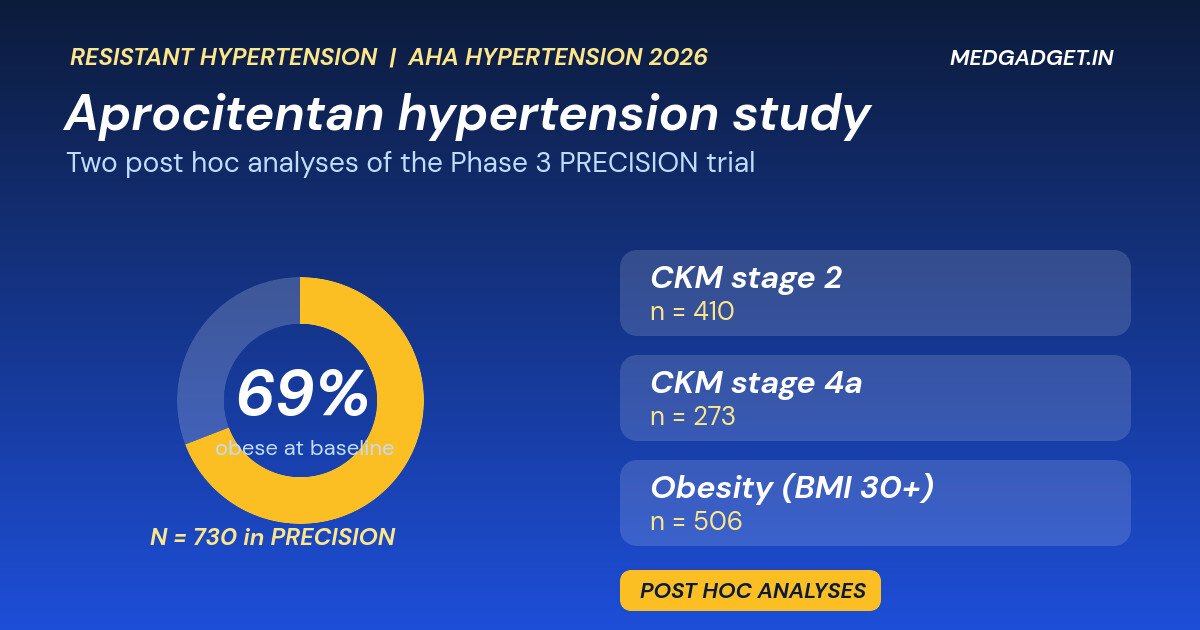
The new aprocitentan hypertension study analyses suggest the drug lowers blood pressure in people with resistant hypertension whether or not they are obese, and across stages of cardiovascular-kidney-metabolic (CKM) disease. Idorsia announced on 12 October 2026 two post hoc analyses of its Phase 3 PRECISION study, which were presented on 10 October at the American Heart Association Hypertension Scientific Sessions 2026 in Arlington, Virginia.
The blood pressure falls look large, and some kidney markers moved in a helpful direction. But these were re-analyses of an existing trial, not new experiments, and the company itself describes the kidney signal as only suggesting a potential benefit. This report explains the numbers, how to read them and what is missing.
Aprocitentan hypertension study: what was reported
- Obesity analysis: 506 patients with a body mass index of 30 or more compared with 224 without obesity, presented by Michael Weber.
- CKM analysis: 410 patients at CKM stage 2 and 273 at stage 4a, presented by John Flack.
- Office systolic blood pressure at week 4, obesity analysis: falls of 15.4 mmHg on 12.5 mg and 16.0 mmHg on 25 mg.
- Office systolic blood pressure at week 4, CKM analysis (12.5 mg): falls of 15.1 mmHg at stage 2 and 16.6 mmHg at stage 4a.
- Kidney markers: urine albumin-to-creatinine ratio (UACR) fell, including by almost 50% in patients with albuminuria, while estimated kidney function (eGFR) stayed stable.
- Other markers: uric acid trended favourably, and NT-proBNP was stable.
Background to the aprocitentan hypertension study: the PRECISION trial
PRECISION was a multicentre, blinded, randomised Phase 3 trial run in Europe, North America, Asia and Australia, listed as ClinicalTrials.gov entry NCT03541174. It enrolled 730 adults whose seated systolic pressure stayed at 140 mmHg or higher despite three blood pressure drugs, including a diuretic.
- Part 1 (4 weeks, double-blind): aprocitentan 12.5 mg (243 people), 25 mg (243) or placebo (244).
- Part 2 (32 weeks): everyone on 25 mg.
- Part 3 (12 weeks, double-blind withdrawal): 307 people re-randomised to 25 mg and 307 to placebo.
The population was high risk. At baseline, 69.2% were obese or severely obese, 54.1% had diabetes, 22.2% had stage 3 to 4 chronic kidney disease and 19.6% had heart failure. In the main published results, the drop in systolic pressure at week 4 was 3.8 mmHg with 12.5 mg and 3.7 mmHg with 25 mg, in both cases statistically significant against placebo.
What the obesity analysis of the aprocitentan hypertension study found
Obesity is common in resistant hypertension, and the company argues that endothelin, a blood-vessel-narrowing signal, is a driver of high pressure in people with obesity. In the post hoc analysis, double-digit falls in systolic pressure were kept through week 36, and night-time ambulatory pressure also fell. UACR decreased, eGFR was stable and uric acid moved favourably against placebo. Safety was described as consistent between people with and without obesity, but no event rates were given.
What the CKM analysis of the aprocitentan hypertension study found
CKM syndrome describes the overlap of obesity, diabetes, chronic kidney disease and heart disease, which tend to worsen each other. In the stage 2 and stage 4a groups, systolic pressure fell by roughly 15 to 17 mmHg at week 4, and daytime and night-time ambulatory readings fell as well, though no values were given. The company says there was no increase in electrolyte abnormalities. By our arithmetic, the two stages cover 683 of the 730 patients, or about 94%, so the remaining 47 patients were presumably at other stages.
How to read the aprocitentan hypertension study numbers
Three cautions matter most.
- The headline falls are not the drug effect alone. The release does not say whether the 15 to 17 mmHg figures are placebo-adjusted. The trial-level difference against placebo was under 4 mmHg, which implies that placebo patients also saw large drops. That is our inference from the published figures, and it means the effect attributable to the drug is smaller than the headline numbers suggest.
- The analyses are post hoc. They were chosen after the trial, which makes false positives more likely. No confidence intervals or p-values for the subgroups were reported.
- The kidney findings are not proof of protection. UACR is a marker, and a fall in a marker does not show that kidney failure, heart attacks or deaths were prevented. The company itself uses the wording “suggesting a potential” benefit.
There is also a conflict of interest to note: both presenters are consultants to Idorsia. And these analyses did not report fluid retention. In the main trial, oedema occurred in 9.1% of patients on 12.5 mg, 18.4% on 25 mg and 2.1% on placebo, and the US label carries a boxed warning that the release does not describe.
Where the aprocitentan hypertension study drug fits in treatment
Aprocitentan is a once-daily oral dual endothelin receptor antagonist that blocks endothelin-1 at both ETA and ETB receptors. Idorsia says it works through a pathway separate from the renin-angiotensin-aldosterone system, which many blood pressure drugs target. It is sold in the United States as TRYVIO, available since October 2024, and as JERAYGO in the EU, UK, Switzerland and Canada for resistant hypertension. The company also says it is included in new ACC/AHA high blood pressure guidelines, a claim we have not checked. The Centers for Disease Control and Prevention offers general background on high blood pressure.
Our assessment of the aprocitentan hypertension study
In our assessment, the aprocitentan hypertension study analyses are useful for doctors treating hard-to-control patients with obesity or kidney disease, because they show the drug did not lose effect in these groups. They do not show that it protects the kidneys, and they should not change practice on their own. A dedicated outcomes trial would be needed for that. For related heart-health news, see our reports on the tovinontrine Phase 2 trial in heart failure and on the cuffless blood pressure ring cleared by the FDA, or browse more pharmaceutical news.
What to watch after the aprocitentan hypertension study
- Full publication of both analyses, with confidence intervals and safety data.
- Any dedicated trial of kidney or cardiovascular outcomes.
- Real-world data on fluid retention and tolerability.
- Further regulatory or guideline decisions on the drug.
Frequently asked questions
What did the aprocitentan hypertension study show?
Two post hoc analyses of the PRECISION trial reported falls in systolic blood pressure of about 15 to 17 mmHg in people with obesity and at CKM stages 2 and 4a, alongside favourable changes in some kidney markers.
Does the aprocitentan hypertension study show kidney protection?
That is not proven. UACR fell, but this is a marker, and the analyses were post hoc.
What is resistant hypertension in the aprocitentan hypertension study?
High blood pressure that stays above target despite three or more drugs, including a diuretic.
What are CKM stages?
A staging system for the overlap of obesity, diabetes, kidney disease and heart disease.
Is the aprocitentan hypertension study drug approved?
Yes, as TRYVIO in the United States and as JERAYGO in the EU, UK, Switzerland and Canada, according to the company.
How we reported this: we relied on the company releases of 5 and 12 October 2026, the main trial results as summarised by the American College of Cardiology, and the trial registry. Results are company-reported and were presented at a conference. Figures labelled as ours are our own calculations. Last updated: 12 October 2026. This article is news reporting and not medical advice.
[…] other recent trials where the headline and the detail did not match, see our reports on the aprocitentan hypertension analysis, the pulmonary fibrosis Phase 3 trial, the tovinontrine heart failure study and the Bristol Myers […]
[…] reading, see our report on tovinontrine in heart failure with reduced ejection fraction and on new aprocitentan hypertension analyses, plus our wider medical device coverage. General background on the condition is available from the […]