

Everest Medicines says China’s drug regulator has accepted its application to manufacture ulcerative colitis drug Velsipity (etrasimod) locally and granted it priority review, a step towards moving production of the medicine into China from 2027. The company announced on 4 October 2026 that the Center for Drug Evaluation of the NMPA accepted the Velsipity manufacturing localization application and placed it on the priority review track. Here is what the step means, what has been confirmed and what has not.
Key Takeaways
- The Center for Drug Evaluation of China’s National Medical Products Administration (NMPA) accepted Everest’s manufacturing localization application for Velsipity and granted priority review.
- Everest says localized production is anticipated to begin in 2027, at a commercial-scale facility in Jiashan, Zhejiang Province, with expected annual capacity of about 50 million tablets.
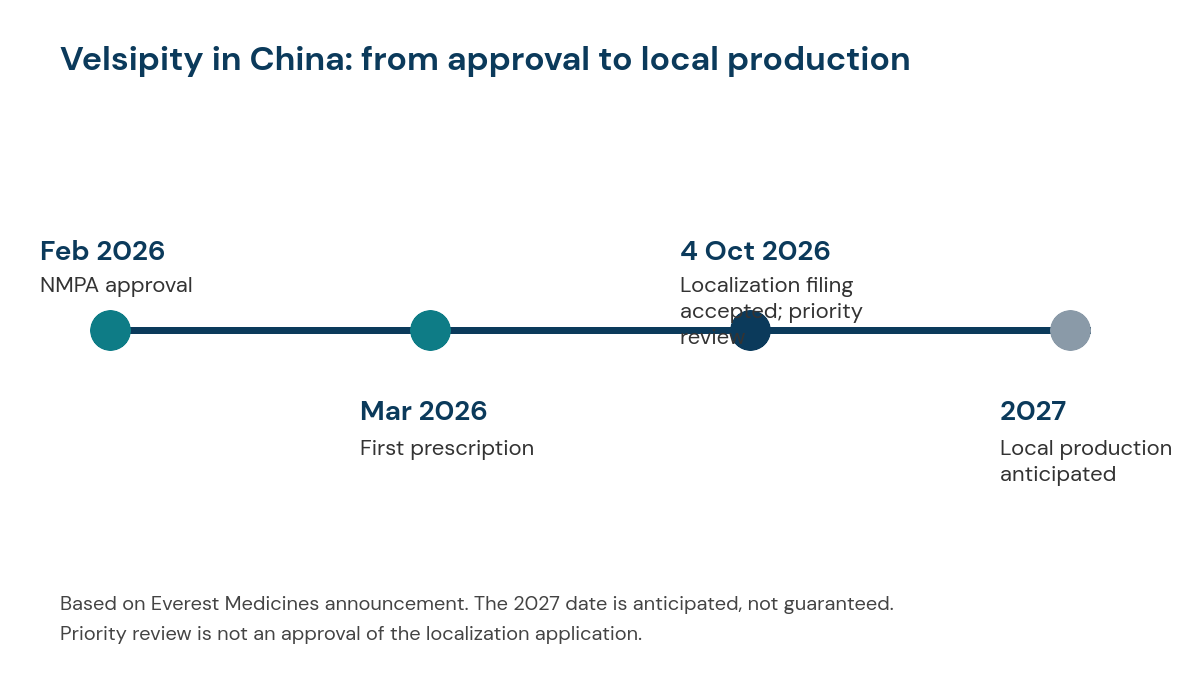
- Velsipity was approved in China in February 2026 for adults with moderately to severely active ulcerative colitis, and the first prescription was written in March 2026.
- Priority review speeds up regulatory assessment but is not an approval. The company has said the 2027 timeline is anticipated, not guaranteed.
- Everest says it is pursuing inclusion of Velsipity in China’s National Reimbursement Drug List (NRDL).
What Did Everest Medicines Announce?
According to the company, the Center for Drug Evaluation accepted the manufacturing localization application, a regulatory filing to make a product that is currently imported at a site inside China, and granted it priority review. Everest describes Velsipity as a next-generation, extremely selective S1P receptor modulator taken as a once-daily oral tablet, with potential for rapid onset of action, sustained clinical remission and mucosal recovery. Those descriptions come from the company.
The localized supply would come from a commercial-scale facility in Jiashan, Zhejiang Province, which the company says has been established with GMP certification meeting Chinese, EU and WHO standards. Production is anticipated to begin in 2027, with expected annual capacity of approximately 50 million tablets.
Velsipity in China at a Glance
| Item | Detail |
|---|---|
| Product | Velsipity (etrasimod arginine tablets), once-daily oral S1P receptor modulator |
| Company | Everest Medicines |
| Regulatory step | Manufacturing localization application accepted by NMPA Center for Drug Evaluation, with priority review (announced 4 Oct 2026) |
| China approval | February 2026, adults with moderately to severely active ulcerative colitis |
| First prescription | March 2026 |
| Local facility | Jiashan, Zhejiang Province; GMP certified (Chinese, EU, WHO standards) |
| Expected capacity | About 50 million tablets a year |
| Localized production | Anticipated to begin in 2027 |
| Other approvals | Hong Kong, Macao, Singapore, South Korea; Taiwan anticipated H2 2026 |
| Reimbursement | NRDL inclusion being pursued |
What Is Velsipity and Who Is It For?
Velsipity is the brand name for etrasimod arginine tablets. It belongs to a class called sphingosine 1-phosphate (S1P) receptor modulators, which are thought to reduce inflammation in the gut by limiting the movement of certain immune cells. In China it is approved for adults with moderately to severely active ulcerative colitis who have had an inadequate response, loss of response or intolerance to conventional therapy or biologics, according to Everest.
Ulcerative colitis is a chronic inflammatory bowel disease that causes inflammation of the colon lining. Patient groups such as the Crohn’s & Colitis Foundation provide general information on the condition and its treatment. Etrasimod was developed by Pfizer, which markets it in the United States, and Everest holds rights in China and other Asian markets under an earlier licensing agreement, which was not part of the latest announcement.
What Does Local Manufacturing Mean for Patients and the Market?
Moving production from imports to a local site can, in principle, make supply more reliable and reduce supply-chain and logistics costs. Everest has said the move supports its commercial momentum. We have not seen the company quantify any price effect, and local manufacturing does not by itself lower prices to patients or hospitals.
By our own calculation, a capacity of about 50 million tablets a year would be enough for roughly 137,000 patient-years at one tablet a day. That is an illustrative figure from the company’s capacity target and says nothing about expected demand or how much of the capacity will be used.
Regional Approvals and Reimbursement
Everest says Velsipity is approved in Mainland China, Hong Kong, Macao, Singapore and South Korea, and that Taiwan approval is anticipated in the second half of 2026. It is also pursuing inclusion in the NRDL, the list negotiated by the National Healthcare Security Administration, which determines which drugs are covered by public insurance and typically sets a negotiated price. Whether and when Velsipity will be listed has not been announced.
Evidence Cited by the Company
Everest points to presentations at the ECCO 2026 and AOCC 2026 conferences, which it says show efficacy for up to three years, long-term safety and tolerability up to five years, and effectiveness in both treatment-naive and biologic-experienced patients. These are company-reported summaries and we have not reviewed the underlying data. Patients should rely on their gastroenterologist for treatment decisions.
What Is Not Yet Known
- When the Center for Drug Evaluation will complete its review of the localization application.
- Whether production will actually begin in 2027 as anticipated.
- Whether localization will change the price of Velsipity or affect NRDL negotiations.
- Sales figures and uptake since the March 2026 launch were not given in the announcement we reviewed.
Related Coverage
For more on pharmaceutical manufacturing and regulation, see our reports on Bayer’s $2.2 billion Ohio plant, the Maharashtra FDA action on a Cipla warehouse and India’s PRIP scheme for pharma R&D.
Our Assessment
In our assessment, the priority review is a positive but early milestone. It shows that regulators are willing to fast-track the move to local production, and it fits a broader pattern of multinational medicines being manufactured closer to their markets. The real test is whether the facility starts producing on time and whether localization translates into better access and pricing. Until then, the 2027 target is a company expectation.
Frequently Asked Questions
What is Velsipity used for?
It is a once-daily oral tablet approved in China for adults with moderately to severely active ulcerative colitis who have not responded well to, or cannot tolerate, conventional therapy or biologics.
What did China’s regulator approve?
Nothing new has been approved. The Center for Drug Evaluation accepted Everest’s manufacturing localization application and granted priority review.
When will Velsipity be made in China?
Everest anticipates localized production to begin in 2027 at its Jiashan facility, expected to have about 50 million tablets of annual capacity.
Is Velsipity covered by insurance in China?
Everest says it is pursuing inclusion in the National Reimbursement Drug List. No listing has been announced.
Who developed etrasimod?
Pfizer developed it, and Everest holds rights in China and several other Asian markets under a licensing agreement.
How we reported this: details come from Everest Medicines’ 4 October 2026 announcement and are company-reported. We did not see a statement from the regulator. Pfizer’s development role and the licensing relationship are background context. Last updated 5 October 2026. This article is for information only and is not medical advice.
[…] CSL Alentis Partnership: $1.6B Lixudebart Deal Explained HeartBeam Wins FDA Breakthrough Status for Heart Attack Tool AIRS Medical SwiftSight Body Composition Cleared by FDA Axogen Completes $200 Million BioCircuit Acquisition Velsipity Local Manufacturing in China Gets Priority Review […]