

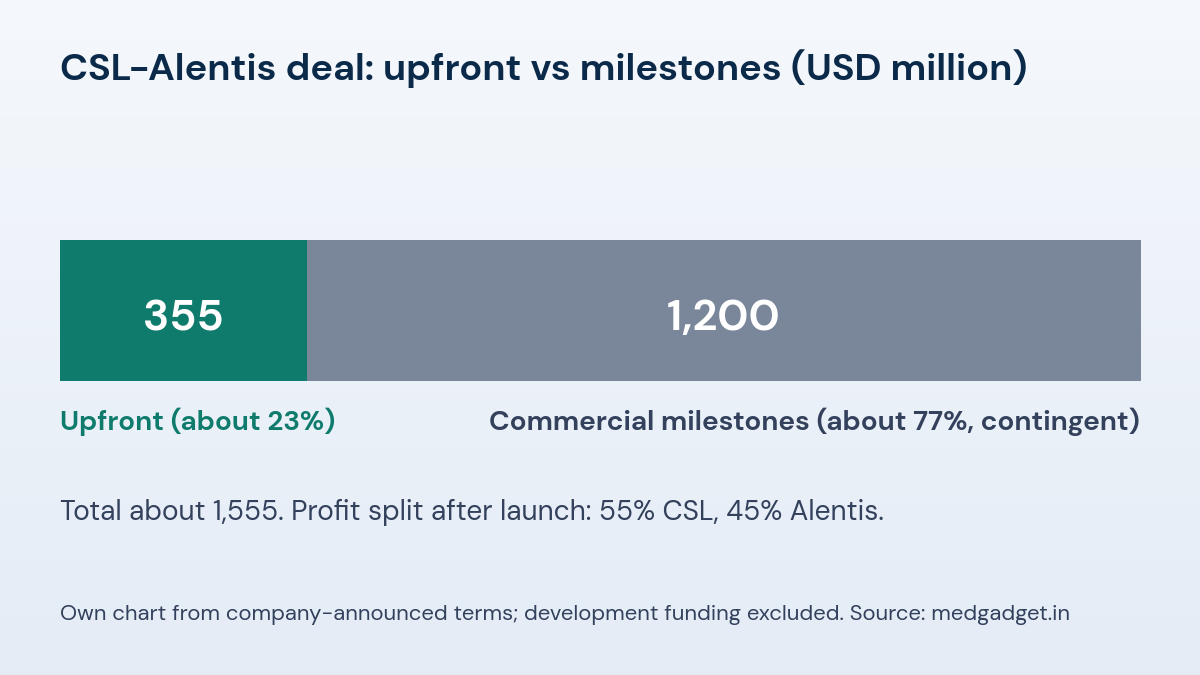
CSL has entered a global partnership with Swiss biotech Alentis Therapeutics to jointly develop and co-promote lixudebart, an experimental antibody for rare kidney and liver diseases. In the CSL Alentis partnership, announced on 5 October 2026, CSL will pay US$355 million upfront, and Alentis can earn up to a further US$1.2 billion in commercial milestones, a combined potential value of about US$1.6 billion.
Key Takeaways
- CSL will make an initial payment of US$355 million to Alentis, which is eligible for up to US$1.2 billion more in commercial milestone payments, according to the companies.
- Once lixudebart is commercialised, global profits will be shared 55% to CSL and 45% to Alentis.
- CSL will fund trial completion and related development work across three lead indications: ANCA-associated vasculitis with rapidly progressive glomerulonephritis (AAV-RPGN), focal segmental glomerulosclerosis (FSGS) and primary sclerosing cholangitis (PSC).
- Lixudebart is an investigational monoclonal antibody that targets claudin-1. It is not approved anywhere, and the clinical data so far are early-stage.
- The “up to US$1.6 billion” figure is a headline maximum. Most of it depends on commercial success that is years away, and development funding comes on top.
What Are the Terms of the CSL Alentis Deal?
The companies describe a co-development and co-promotion arrangement rather than a straight licence. CSL pays US$355 million at the outset and funds the development programme, while Alentis keeps a 45% share of global profits after launch and is eligible for the milestone payments tied to commercial performance.
| Term | Detail |
|---|---|
| Partners | CSL and Alentis Therapeutics (Basel, Switzerland) |
| Announced | 5 October 2026 |
| Candidate | Lixudebart (ALE.F02), anti-claudin-1 monoclonal antibody |
| Upfront payment | US$355 million |
| Commercial milestones | Up to US$1.2 billion |
| Headline value | About US$1.555 billion (own sum), excluding development funding |
| Profit split after launch | 55% CSL, 45% Alentis |
| Lead indications | AAV-RPGN, FSGS, PSC |
| Development funding | Funded by CSL |
By our own calculation, the upfront payment is roughly 23% of the US$1.555 billion headline (355 divided by 1,555). That means about three-quarters of the figure is contingent. Some reports quote the value in Australian dollars, which produces a larger headline number; the contract terms are stated in US dollars.
What Is Lixudebart?
Lixudebart (also known as ALE.F02) is an investigational monoclonal antibody that targets claudin-1, a protein found in the tight junctions between cells. According to the companies, it binds an exposed form of claudin-1 that appears in diseased tissue, with the aim of acting on both inflammatory and fibrotic signalling. Fibrosis is the scarring that gradually reduces organ function in many kidney and liver diseases.
Two early trials underpin the deal, according to the companies. In the Phase 2 RENAL study in AAV-RPGN, interim data in 26 patients showed improvements in kidney function and proteinuria at 24 weeks. In the Phase 1b FEGATO study in 41 patients with advanced liver fibrosis, liver function improved after six weeks. Both studies reported dose-dependent target engagement with a favourable safety and tolerability profile. These are company-reported, interim and uncontrolled early data, and we have not seen the full results.
Which Diseases Are Targeted?
- AAV-RPGN: an autoimmune small-vessel inflammation that can damage the kidney filters quickly. CSL’s R&D head said patients face rapid decline in kidney function and risk irreversible damage even with current treatments.
- FSGS: focal segmental glomerulosclerosis is a pattern of scarring in the kidney’s filtering units that can lead to kidney failure.
- PSC: primary sclerosing cholangitis is a chronic bile-duct disease that causes inflammation and scarring in the liver.
These are rare conditions, which is why programmes of this kind often qualify for rare-disease incentives such as those under the FDA orphan drug programme. The companies have not said that lixudebart holds orphan designation in these specific diseases.
Why Does This Matter for CSL?
CSL is best known for plasma-derived therapies, vaccines and its renal and iron-deficiency products. A claudin-1 antibody for kidney and liver disease would extend its rare-disease and nephrology pipeline. The company has framed the potential in terms of improving kidney function, a goal that many current treatments for these conditions do not achieve. For Alentis, a private biotech based in Basel, the deal provides funding to run several late-stage programmes in parallel; its chief executive, Dr Mark Pruzanski, said the partnership would let the company accelerate development in several indications at once.
What Is Not Yet Known
- Whether the early kidney and liver signals will hold up in larger, controlled Phase 3 studies.
- The timing of pivotal trials and any regulatory filings, which the companies have not set out.
- The structure and size of the development funding, which sits outside the headline figure.
- The sales thresholds that trigger the US$1.2 billion in commercial milestones.
- Any closing conditions or regulatory approvals the transaction still needs.
Related Coverage
For more on pharma deals and manufacturing, see our reports on Everest Medicines’ VELSIPITY manufacturing and priority review, Axogen’s BioCircuit acquisition and the trade-margin talks for medical devices.
Our Assessment
In our assessment, the structure matters more than the headline. A US$355 million upfront payment plus full funding of the development programme is a serious commitment for an antibody that has so far been tested in small early trials, and the 55/45 profit split gives Alentis real participation in the upside. But the biggest part of the value is contingent on sales, so the deal is best read as a bet on controlled data still to come, not a validation of the drug.
Frequently Asked Questions
How much is the CSL Alentis deal worth?
Up to about US$1.6 billion: US$355 million upfront plus up to US$1.2 billion in commercial milestones, excluding CSL-funded development costs.
What is lixudebart used for?
It is an investigational antibody being studied in AAV-RPGN, FSGS and PSC. It is not approved for any use.
How will profits be shared?
Once commercialised, global profits will be shared 55% to CSL and 45% to Alentis, according to the companies.
Who pays for development?
CSL will fund the completion of the Phase 2 RENAL study, the Phase 3 AAV-RPGN programme, and the FSGS and PSC studies, plus supporting activities.
Is lixudebart available to patients?
No. Patients should speak to their doctors about approved options and clinical trials.
How we reported this: details come from the joint announcement by CSL and Alentis dated 5 October 2026 and related reports. Trial results and financial terms are company-reported. This is not medical or investment advice. Last updated 6 October 2026.
[…] Expands Gate Bioscience Deal to Over $870 Million CSL Alentis Partnership: $1.6B Lixudebart Deal Explained HeartBeam Wins FDA Breakthrough Status for Heart Attack Tool AIRS Medical SwiftSight Body […]
[…] Epcoritamab Plus R-CHOP Cuts Risk 51% Lilly Expands Gate Bioscience Deal to Over $870 Million CSL Alentis Partnership: $1.6B Lixudebart Deal Explained HeartBeam Wins FDA Breakthrough Status for Heart Attack […]