

Pennsylvania has recorded the largest measles outbreak in decades for any US state. State officials describe it as the largest state outbreak in more than three decades after cases passed 1,000 in early October 2026, and the count has kept rising since. The outbreak began in April west of Philadelphia and now spans dozens of counties.
We have followed the daily counts and the deaths in earlier reports. This article steps back to ask a different question: how does this outbreak compare with the past, what makes it unusual, and what does it say about measles in the United States now?
Largest measles outbreak in decades: key points
- Size: between 1,078 and 1,105 cases, depending on whether you use the state’s 7 October update or the CDC’s 8 October figure.
- Rank: the largest US state outbreak since the early 1990s, according to state officials and reports.
- Deaths: five reported by the state; the CDC has recognised two.
- Vaccination: only four cases were in vaccinated people, under 1%.
- Response: more than 53,000 MMR doses given in September, over double the usual monthly volume.
How the largest measles outbreak in decades ranks against earlier ones
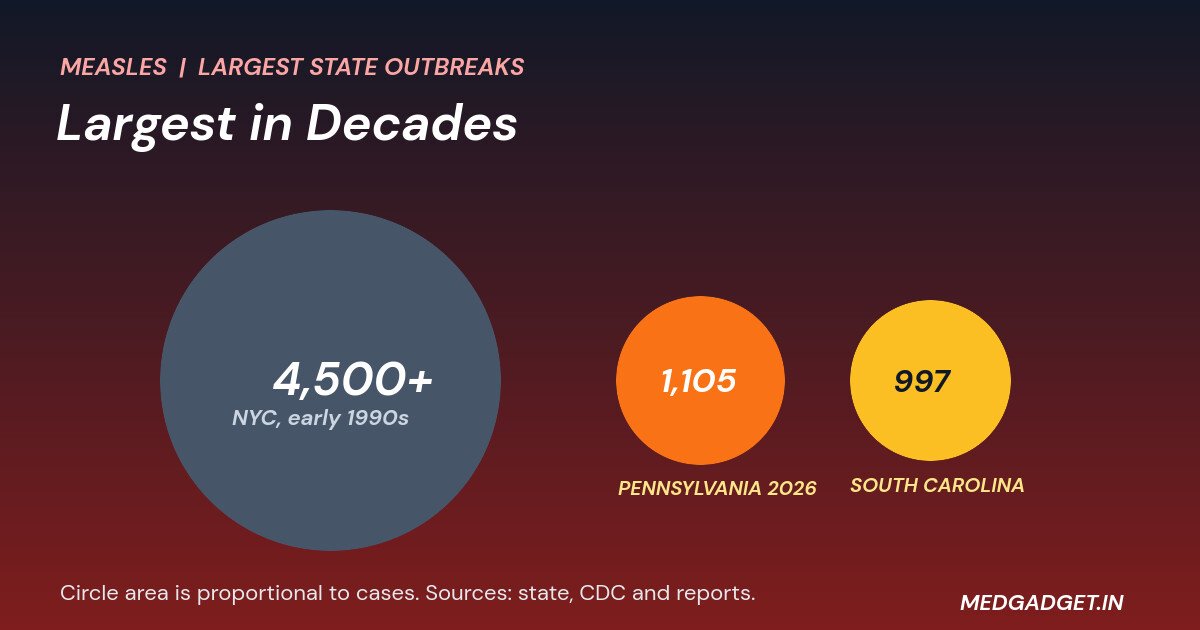
Reports put the Pennsylvania outbreak in a short list of very large ones. The previous largest in recent years was in South Carolina, which reached 997 cases. The last state outbreak above 1,000 cases was a multiyear outbreak in New York City in the early 1990s that infected more than 4,500 people.
- Pennsylvania, 2026: more than 1,000 cases and counting, in a few months.
- South Carolina, 2026: 997 cases in the earlier outbreak, the largest before Pennsylvania’s; the CDC now lists 670 for the state this year, so the two sets of numbers measure different things.
- New York City, early 1990s: more than 4,500 cases over several years.
By our calculation, Pennsylvania’s 1,105 cases are about 11% more than South Carolina’s 997 and no more than about a quarter of the New York City total, which was spread over several years. Those comparisons are our own arithmetic and mix different definitions of an outbreak, so they are a guide to scale and not a ranking by an official body.
Why this is the largest measles outbreak in decades
Three things stand out. The first is speed: the outbreak began in late April and passed 1,000 cases within about five months. By our calculation, that is an average of roughly 47 cases a week between late April and 7 October, though cases come in waves and reporting lags make the true weekly pattern uneven.
The second is severity. The state reports 207 hospitalisations among 1,078 cases, which is about 19% by our calculation, and five deaths. The first two deaths, announced on 25 August, were described by the governor’s office as the state’s first measles-associated deaths in 35 years. One report says the US has recorded eight measles-associated deaths in the past two years, more than in the previous three decades combined.
The third is who is affected. Only four of the state’s cases were in vaccinated people. The outbreak is overwhelmingly one in unvaccinated communities, which is what the vaccine data predict.
Counting differences in the largest measles outbreak in decades
- The state’s count of 1,078 on 7 October included a catch-up: more than 40 of the 74 new cases that week involved people who fell ill over two weeks earlier and were only then confirmed.
- One news report put the total at 1,004 as of 6 October, a figure that appears to lag the state’s update.
- The CDC’s count of 1,105 is as of 8 October and covers the same period with a different reporting schedule.
- Deaths differ: five from the state versus two recognised by the CDC, a dispute the governor has raised publicly.
For the freshest figure, check the Pennsylvania Department of Health dashboard, which is the primary source. Our earlier reports track the counts as they moved: 977 cases on 2 October, 1,078 cases on 7 October and the additional deaths in September.
What is driving the largest measles outbreak in decades
The United States eliminated domestic measles spread in 2000, but vaccination coverage has fallen below the roughly 95% needed to prevent outbreaks. Officials and reports point to parental waivers, difficulty reaching health care and misinformation as reasons fewer children receive routine vaccines. The CDC data show kindergarten MMR coverage at 92.4% in 2025–2026, down from 95.2% in 2019–2020.
Outbreaks tend to start where coverage is lowest, and measles then spreads quickly: the Centers for Disease Control and Prevention (CDC) says up to nine in ten unprotected people who are exposed become infected, and the virus can linger in the air for up to two hours. A single case in a close-knit community with low coverage can seed a large outbreak, as happened in earlier outbreaks in Texas, Utah and South Carolina.
The national picture beyond the largest measles outbreak in decades
Pennsylvania is the most visible part of a bigger problem, and the largest measles outbreak in decades sits inside a national surge. The CDC counts 4,080 confirmed US cases in 2026, the highest since 1991, and Pennsylvania accounts for about 27% of them, by our calculation. We set out the national figures in our report on US measles cases passing 4,000.
Reports also say that in November, international health officials will decide whether the United States and Mexico have lost their measles-free status. The Pan American Health Organization works with national governments on that review. We have not seen a formal decision, and the outcome is for those officials to announce.
What officials ask people to do during the largest measles outbreak in decades
Secretary of Health Dr. Debra Bogen has urged unvaccinated people to get vaccinated, and warned that early measles symptoms, such as fever, cough and runny nose, look very similar to common respiratory viruses. The state says two documented doses of MMR give about 97% protection. Children aged 18 and under who are on Medicaid, uninsured or underinsured can get the vaccine at no cost at state health centres. Vaccination has risen sharply, with a later report citing more than 56,000 doses in September, though the state’s earlier figure was over 53,000.
Our assessment
In our assessment, the label “largest in decades” is accurate by case count but understates the real story: the outbreak is large, fast and deadly in a country that had nearly forgotten measles deaths. The sharp rise in vaccine uptake is encouraging, but it will take weeks to show up in case numbers, because infections reported now began two to three weeks ago.
For more public-health coverage, browse our pharmaceutical news section.
What to watch next in the largest measles outbreak in decades
- Whether weekly new cases in Pennsylvania slow after the surge in vaccinations.
- Any change in the CDC’s count of measles deaths.
- The November decision on measles-free status.
- Spread to neighbouring states and new outbreaks elsewhere.
Frequently asked questions
Is this the largest measles outbreak in decades in the US?
For a single state, yes. State officials call it the largest state outbreak in more than three decades, since the multiyear New York City outbreak in the early 1990s.
How many measles cases are there in Pennsylvania?
The state reported 1,078 on 7 October, and the CDC listed 1,105 as of 8 October.
How many people have died?
Five deaths are reported by the state; the CDC has recognised two.
When did the outbreak start?
In April 2026, west of Philadelphia.
How can I protect my family?
Check that children and adults have two documented MMR doses, and call a doctor before visiting if you think you have measles.
How we reported this: we relied on Pennsylvania Department of Health updates, CDC data and public reports published between 5 and 10 October 2026. Counts differ between sources and change quickly. Figures labelled as ours are our own calculations. Last updated: 10 October 2026. This article is news reporting and not medical advice.
[…] to Know If You Were Exposed to Measles: 7 Key Steps Largest Measles Outbreak in Decades: Pennsylvania Tops 1,000 US Measles Cases Top 4,000 in 45 States: Worst Since 1991 340B Drug Pricing Program Lawsuit: $1B […]