

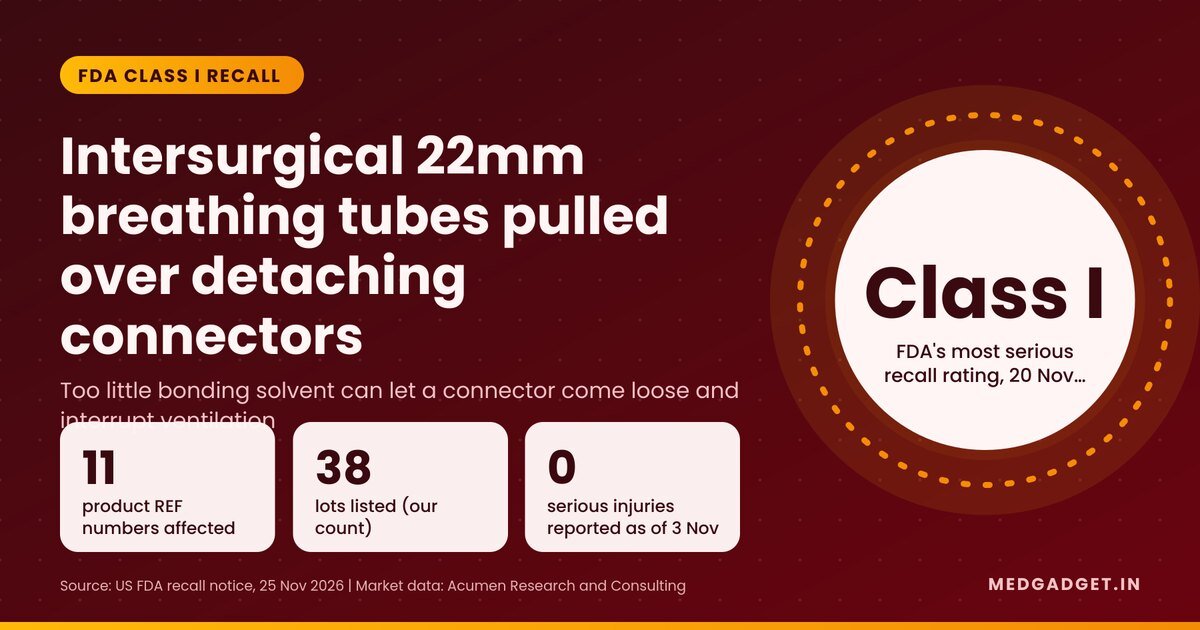
The Intersurgical breathing tube recall is now officially in the US Food and Drug Administration’s most serious category: on 20 November 2026 the agency classified Intersurgical Inc.’s removal of certain 22mm Smoothbore breathing tubes and breathing systems as Class I, and on 25 November it updated its public notice to confirm the affected products and instructions are unchanged. Eleven product reference numbers are involved, spanning ventilator, heated-wire and bilevel circuits, because a soft connector on the tube may come loose and cut off a patient’s ventilation.
The company first warned customers in a letter dated 3 November, and the FDA posted an early alert on 10 November. As of 3 November, Intersurgical had reported no serious injuries or deaths linked to the problem.
Key takeaways on the Intersurgical breathing tube recall
- The FDA rates the action Class I, meaning continued use could cause serious injury or death.
- Affected items are 22mm Smoothbore tubes and breathing systems under 11 REF numbers; by our count the FDA table lists 38 lot numbers.
- The root cause is too little tetrahydrofuran (THF) solvent used to bond soft end connectors to the tubing, so a connector can detach.
- A detached connector can interrupt ventilation, and a patient may desaturate until someone restores breathing support manually.
- Facilities should stop using and quarantine the listed lots, return them to Intersurgical and pass the notice to every user.
- No serious injuries or deaths had been reported as of 3 November 2026.
Why a solvent bond matters on a breathing circuit
A breathing circuit is the tubing that carries gas from a ventilator, anaesthesia machine or bilevel device to the patient and back. The 22mm Smoothbore range uses soft connectors at the tube ends that are chemically welded in place with THF, a solvent that softens the plastics so they fuse as it evaporates. If too little solvent is applied, the joint can look normal but hold weakly.
According to the FDA notice, the problem surfaced through reports of connectors detaching in markets outside the United States. That triggered internal testing, which found that some products had been made with an insufficient amount of solvent. In other words, the defect is in manufacturing consistency rather than design, which is why the action targets specific lots rather than the whole product line.
The consequence of a disconnection depends on the patient and the moment it happens. For someone fully dependent on a ventilator, a sudden break in the circuit means no effective breathing support until a clinician notices the alarm and reconnects or replaces the tubing. The FDA lists organ failure, brain damage and death from hypoxia as the worst outcomes.
Which Intersurgical products are affected
The table below summarises the reference numbers in the FDA notice. Lot counts are by our calculation from the FDA’s lot table; facilities should check exact lot numbers against the official list before acting.
| REF | Product type (short description) | Lots listed |
|---|---|---|
| 5018000 | 22mm Smoothbore tube with soft end connectors | 1 |
| 5025000 | Single heated-wire breathing system with water trap | 1 |
| 5025310 | Single heated-wire system with water trap and auto-fill chamber | 1 |
| 5026000 | Dual heated-wire breathing system | 1 |
| 5183000 | Breathing system with monitoring line and exhalation valve | 1 |
| 5191000 | Single-limb system with monitoring line and exhalation valve | 3 |
| 5191850 | Exhalation-valve heated-wire system with monitoring line and extra limb | 2 |
| 5194850 | Exhalation-valve heated-wire system with extra limb | 1 |
| 5804000 | Bilevel breathing system with swivel CO2 leak port | 7 |
| 5805000 | Bilevel system with monitoring line and swivel CO2 leak port | 2 |
| 5805030 | Bilevel system with leak port and Clear-Guard Midi filter | 18 |
| Total | 38 | |
Two points stand out. First, the bilevel circuits (the 5804000, 5805000 and 5805030 references) account for 27 of the 38 lots, so home and hospital non-invasive ventilation users are the largest exposed group. Second, the FDA has not published a unit count or distribution window, so the scale in boxes on shelves is not yet public.
Timeline of the recall
- 3 November 2026: Intersurgical sends an urgent letter to customers asking them to stop use and quarantine affected lots.
- 10 November 2026: The FDA posts an early alert about the removal.
- 20 November 2026: The FDA classifies the action as Class I, its most serious recall type.
- 25 November 2026: The FDA updates the notice; the affected products and recommendations stay the same.
What hospitals, clinics and home-care providers should do
The instructions in the company letter, as relayed by the FDA recall notice, are direct:
- Check stock in wards, theatres, respiratory departments and home-care inventories against the listed REF and lot numbers.
- Stop using and quarantine any matching product immediately.
- Return affected product to Intersurgical.
- Share the notice with everyone in the facility who uses these circuits, and contact downstream customers if you redistributed the product.
For patients at home on a bilevel or ventilator circuit, the practical step is to contact the equipment supplier or care team, who can confirm the lot number on the packaging and arrange a replacement. Patients should not disconnect therapy on their own without a substitute in place. Even with unaffected tubing, good practice is to keep ventilator disconnection alarms switched on and audible.
Because the first detachment reports came from outside the US, buyers in other countries, including India, may want to ask their distributors whether the same lots were supplied locally and whether a field safety notice has been issued by their own regulator. The FDA notice itself covers the US action only. Our earlier coverage of the Philips sleep apnoea device recall and the Philips Respironics DOJ agreement shows how respiratory device problems can ripple across many markets at once.
Market context: a modest-sized but essential device category
Breathing circuits are low-cost disposables, but they sit in every operating theatre, ICU and many homes. According to Acumen Research and Consulting, the global breathing circuits market was worth USD 1,093.6 million in 2021 and is projected to reach USD 1,774.2 million by 2030, a compound annual growth rate of 5.6%. Acumen also identifies Asia-Pacific as the fastest-growing region. That report was last updated in October 2022, so treat the figures as indicative rather than current.
The size of the category helps explain why quality lapses matter: a single bonding error repeated across production lots can reach thousands of patients through hospital supply chains before anyone sees a failure in practice.
What we still do not know
- How many units were distributed in the US, and over what dates.
- How many detachment reports were received outside the US, and in which countries.
- Whether any injuries have been reported since the 3 November cut-off.
- What process change Intersurgical has made to ensure correct solvent levels in future lots.
FAQ
Why are Intersurgical breathing tubes being recalled?
Some 22mm Smoothbore tubes and systems were made with too little THF solvent bonding the soft connectors to the tube, so a connector can detach and interrupt ventilation.
What does a Class I recall mean?
It is the FDA’s most serious recall category, used when continued use of a product may cause serious injury or death.
Have any patients been harmed?
As of 3 November 2026, Intersurgical had reported no serious injuries or deaths. The FDA has not published a later figure.
How do I check if my breathing circuit is affected?
Compare the REF and lot number on the packaging with the list in the FDA notice, or ask your equipment supplier. US customers can reach Intersurgical customer service on 800-828-9633.
Sources: US FDA recall notice (updated 25 November 2026); Intersurgical customer letter dated 3 November 2026 as summarised by the FDA. Market data: Acumen Research and Consulting, Breathing Circuits Market report (last updated October 2022). This article is for information only and is not medical advice. More in Medical Device. Last updated 27 November 2026.