


The US Food and Drug Administration has cleared AIRS Medical’s SwiftSight Body Composition, an AI-powered software that measures fat, muscle and liver fat from a magnetic resonance imaging (MRI) scan of under five minutes. The company announced the 510(k) clearance on 5 October 2026. The SwiftSight Body Composition tool turns routine MRI into a quantitative report that tracks body composition over time, and SimonMed Imaging will be its first customer.
Key Takeaways
- FDA granted 510(k) clearance to SwiftSight Body Composition, announced on 5 October 2026.
- The software measures visceral and subcutaneous fat, abdominal and thigh muscle, muscle quality and balance, and liver fat using proton density fat fraction (PDFF).
- The scan takes under five minutes. AI segments the images and compares results with age- and sex-matched reference populations.
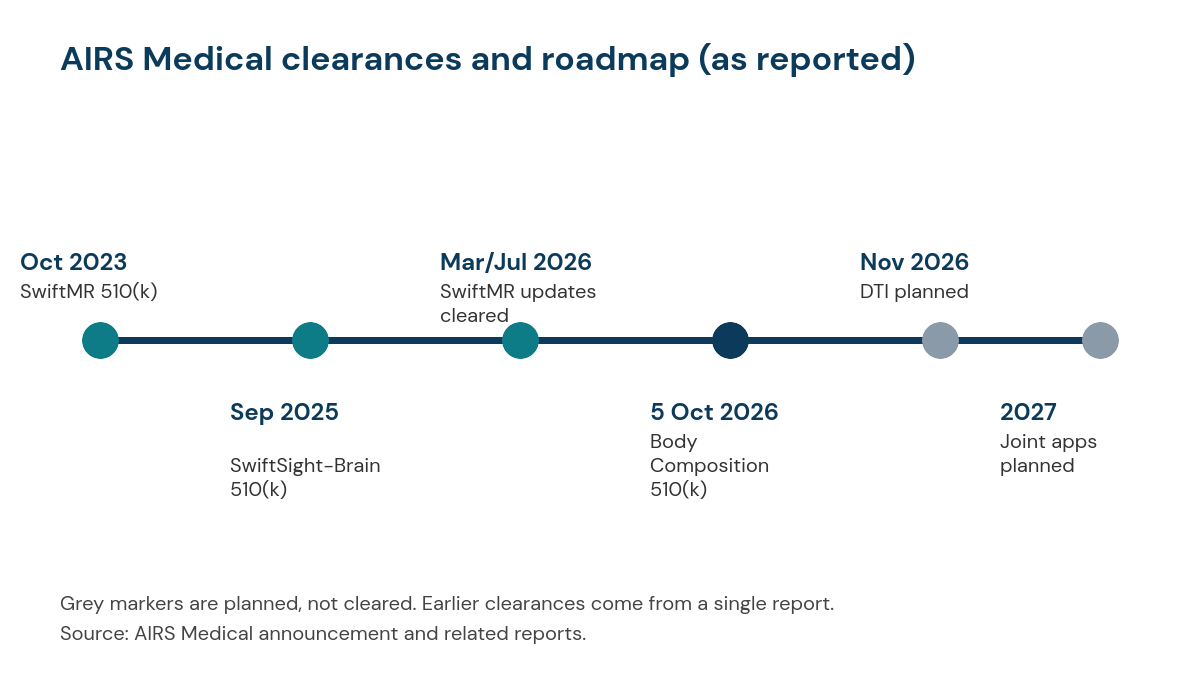
- SimonMed Imaging will be the first deployment site. The roadmap includes diffusion tensor imaging in November 2026 and quantitative joint applications in 2027.
- The announcement did not describe validation studies for this product, and clearance does not by itself show clinical outcome benefit.
What Did FDA Clear?
SwiftSight Body Composition is an AI-powered quantitative MRI solution. It performs an MRI scan of the abdomen, liver and thigh and applies automated AI segmentation, which means the software outlines tissues on the images and calculates their size and composition. The results are benchmarked against age- and sex-matched reference populations and delivered in a standardised Body Composition Report with quantitative measurements, percentile rankings and visual summaries.
A 510(k) clearance means the FDA found the device to be substantially equivalent to a legally marketed device. It is not the same as approval of a new drug and it does not by itself establish that using the tool improves patient outcomes. Details of the submission can be searched in the FDA 510(k) database once posted.
SwiftSight Body Composition at a Glance
| Item | Detail |
|---|---|
| Product | SwiftSight Body Composition, AI-powered quantitative MRI software |
| Company | AIRS Medical |
| Regulatory status | FDA 510(k) clearance, announced 5 October 2026 |
| Scan time | Under five minutes |
| Measures | Visceral and subcutaneous fat; abdominal and thigh muscle; muscle quality and balance; liver fat (PDFF) |
| Output | Standardised Body Composition Report with percentiles vs age- and sex-matched references |
| First customer | SimonMed Imaging |
| Roadmap | Diffusion tensor imaging (Nov 2026); quantitative joint applications (2027) |
What Does It Measure?
The company says the tool quantifies visceral fat, the fat around internal organs, and subcutaneous fat under the skin, along with abdominal and thigh muscle. It also reports muscle quality, bilateral muscle balance and, according to one report, intramuscular fat infiltration (myosteatosis). Liver fat is measured with proton density fat fraction, an MRI technique widely used to quantify fat content in the liver. Core muscles named include the abdominal wall, psoas and paraspinal muscles, and leg muscles such as the quadriceps, hamstrings and adductors.
Liver fat is of interest because fatty liver disease is common and linked to metabolic health. General information is available from the National Institute of Diabetes and Digestive and Kidney Diseases. The announcement does not claim that the software diagnoses any disease.
Who Is It For?
The intended applications described include preventive health, weight management, longevity programmes, metabolic assessment and rehabilitation or performance monitoring. Jina Park, the company’s chief strategy officer, said body composition becomes more meaningful when people can track change over time, which points to repeat scanning as a core use. Chief product officer Ajit Shankaranarayanan said the next phase of MRI is not just better images but standardised quantitative information. The announcement did not mention medicines for weight loss or sarcopenia, though readers following our report on trevogrumab and muscle preservation during semaglutide weight loss will recognise why muscle measurement is attracting attention.
The Company and Its Product Family
AIRS Medical describes itself as an MRI intelligence company that helps imaging organisations get more from existing MRI infrastructure. Its SwiftMR software uses AI to reconstruct MRI images and shorten scan time, and one report says it is FDA-cleared, CE-marked and approved in Korea and Japan, in more than 40 countries. The same report says the company received 510(k) clearance for SwiftSight-Brain in September 2025 and for SwiftMR in October 2023, March 2026 and July 2026. SwiftSight-Brain, a related product, is reported to be built on a normative database of 32,615 adults aged 18 to 97 scanned on Siemens, GE Healthcare and Philips systems, but that figure does not describe the new body composition tool.
What Is Not Yet Known
- Clinical validation data for SwiftSight Body Composition and how its measurements compare with reference methods.
- The reference population used for the percentile rankings.
- Pricing, reimbursement and what patients will pay for scans, which is typically outside insurance for wellness uses.
- Whether and when the software will be available outside the United States.
Related Coverage
For more on imaging, AI and device policy, see our reports on the AI in neurosurgery market, the AIIMS Delhi’s AI mammography technology transfer and the parliamentary panel’s call for wider device price control.
Our Assessment
In our assessment, the clearance is a notable step towards MRI as a quantitative tool rather than only a picture. Body composition measured without radiation and in under five minutes is attractive for people who want to track fat and muscle over time, but the value depends on accuracy and on whether the numbers change decisions. Until validation data are published, the claims are the company’s own, and users should treat percentile rankings as informational.
Frequently Asked Questions
What is SwiftSight Body Composition?
It is AI software cleared by the FDA that analyses MRI scans to measure fat, muscle and liver fat in the abdomen, liver and thigh.
How long does the scan take?
The company says the MRI scan takes under five minutes, followed by automated AI analysis.
What does the report show?
Quantitative measurements, percentile rankings against age- and sex-matched references and visual summaries.
Who will use it first?
SimonMed Imaging will be the first deployment site.
What comes next for AIRS Medical?
The company plans diffusion tensor imaging in November 2026 and quantitative joint applications in 2027.
How we reported this: details come from AIRS Medical’s announcement of 5 October 2026 and related reports. Product claims are company-reported, and background on earlier clearances comes from a single report. Last updated 6 October 2026. This article is for information only and is not medical advice.