

The US Food and Drug Administration has granted Breakthrough Device Designation to HeartBeam for its 3D ECG technology, which is being developed to help physicians assess a suspected heart attack outside hospitals, including at home. The company announced the designation on 5 October 2026. The HeartBeam Breakthrough Device Designation speeds up FDA interaction on the technology, but it is not a clearance, and the system is not currently cleared to assess heart attacks.
Key Takeaways
- FDA granted Breakthrough Device Designation to the HeartBeam System for assessing potential heart attacks (myocardial infarction) at home, announced on 5 October 2026.
- The company says the designation was granted within 30 days of its request. It does not mean the device is cleared or approved for this use.
- The system captures the heart’s electrical signals from three non-coplanar dimensions and synthesises a 12-lead ECG using a portable, cable-free recorder with five electrodes, according to the company.
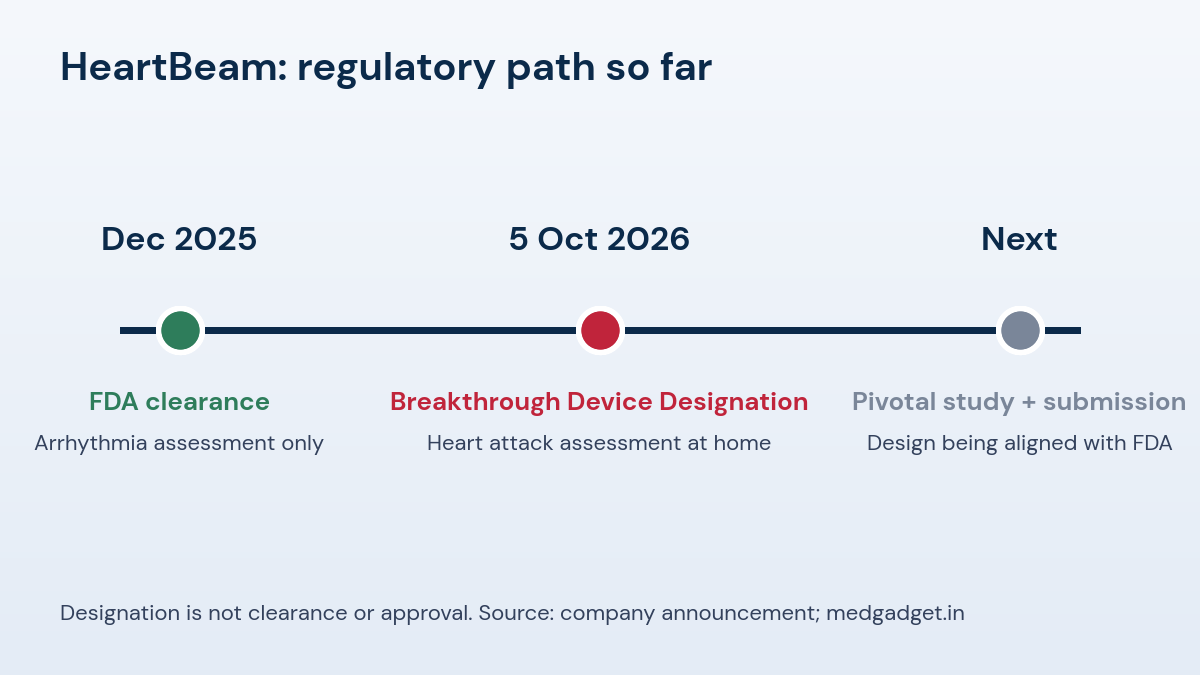
- HeartBeam’s existing FDA clearance, granted in December 2025, covers arrhythmia assessment and is explicitly not intended for heart attack or ischaemia assessment.
- A pivotal study design is still being aligned with the FDA, and patient enrolment is expected to follow.
What Is Breakthrough Device Designation?
The FDA’s Breakthrough Devices Program is meant to speed development and review of devices that may provide more effective treatment or diagnosis of life-threatening or irreversibly debilitating conditions. Designation gives the company prioritised FDA interaction and collaboration on clinical and regulatory pathways. It does not change the evidence the FDA requires for clearance or approval.
HeartBeam says the designation also makes the system eligible for expedited Medicare coverage under the proposed RAPID pathway, under which the Centers for Medicare & Medicaid Services would issue a proposed national coverage determination on the same day the FDA grants clearance. The company also says it has been enrolled in the FDA’s Total Product Life Cycle Advisory Program. These are company statements and the RAPID pathway is described as proposed.
HeartBeam Breakthrough Designation at a Glance
| Item | Detail |
|---|---|
| Company | HeartBeam, Inc. (Santa Clara, California; NASDAQ: BEAT) |
| Designation | FDA Breakthrough Device Designation, announced 5 October 2026 |
| Device | HeartBeam System, 3D ECG with 12-lead synthesis |
| Proposed use | Help physicians assess suspected heart attack (MI), including at home |
| Technology | Portable, cable-free recorder; five electrodes; three non-coplanar signal dimensions |
| Supporting evidence | 2025 AHA proof-of-concept data; 134-patient ALIGN-ACS pilot study |
| Existing clearance | December 2025, arrhythmia assessment only (not for MI or ischaemia) |
| Next step | Align pivotal study design with FDA; enrol patients |
How Does the 3D ECG Work?
A standard 12-lead ECG uses ten electrodes placed on the chest and limbs. HeartBeam’s system instead records the heart’s electrical activity from three non-coplanar directions with a small recorder and five electrodes, and then synthesises the equivalent of a 12-lead ECG. The company says the device can be used by adult patients in a clinical setting or at home. The announcement does not explain the analysis methods in detail, and we have not seen independent data on how closely the synthesised ECG matches a conventional one in heart attack patients.
The point of home use is time. The cardiologist quoted by the company, Dr Tony Das of its scientific advisory board, said one of the biggest gaps in heart attack care occurs before the patient arrives at the hospital, and that the technology could enable earlier intervention. That is the company’s framing of the opportunity, not an established clinical result.
What Evidence Supports the Designation?
HeartBeam says the designation was supported by proof-of-concept data presented at the 2025 American Heart Association Scientific Sessions and by a 134-patient pilot study known as ALIGN-ACS. The company says it expects to announce updates on ALIGN-ACS at the TCT conference and on a study called HEADSTART-ACS in the coming weeks. We have not seen the underlying data, so the performance of the system in detecting heart attacks is not yet independently established.
Important Safety Note
Anyone with symptoms of a heart attack, such as chest pain or pressure, pain spreading to the arm or jaw, shortness of breath or sweating, should call emergency services immediately and should not wait to use a home device. The HeartBeam System is not cleared to assess heart attacks, and the designation does not change that.
What Happens Next?
HeartBeam says it expects FDA alignment on a pivotal study design in the coming months, with patient enrolment anticipated shortly afterwards, and the pivotal study is described as multicentre. Only after that study and a regulatory submission could the FDA clear the system for heart attack assessment. The timing of that is not given. The company estimates the heart attack market opportunity at about $15 billion within a broader cardiac platform opportunity exceeding $40 billion, and says more than 20 million US adults are at elevated risk of heart attack. Those are company estimates.
What Is Not Yet Known
- How accurate the system is at detecting heart attacks compared with a standard hospital ECG, including in people with non-ST-elevation events.
- The design, size and endpoints of the pivotal study.
- How patients would be advised to use the device and who would review the readings.
- Pricing, reimbursement outside the proposed RAPID pathway, and any availability outside the United States.
Related Coverage
For more on medical technology and policy, see our reports on the artificial organs market forecast, the da Vinci 5 launch in India, the trade-margin talks for medical devices and the AIIMS Delhi’s AI mammography technology transfer.
Our Assessment
In our assessment, the designation is a meaningful regulatory milestone, because it signals that the FDA sees potential value in a home tool for suspected heart attack, but it is a long way from a cleared product. The central question is accuracy: a home device that misses a heart attack, or generates false alarms, could do harm. Pivotal data in a realistic population will decide whether the idea works, and until then patients should rely on emergency services rather than devices.
Frequently Asked Questions
What did the FDA grant HeartBeam?
Breakthrough Device Designation for the HeartBeam System for assessing potential heart attacks at home. It is not a clearance or approval.
Can the device detect a heart attack now?
No. Its December 2025 clearance covers arrhythmia assessment and is not intended for heart attack or ischaemia assessment.
How does the 3D ECG work?
It records the heart’s electrical signals from three non-coplanar dimensions using five electrodes and synthesises a 12-lead ECG, according to the company.
When could it be cleared for heart attack assessment?
No date has been given. A pivotal study design must first be agreed with the FDA, and the study completed.
What should I do if I think I am having a heart attack?
Call emergency services immediately.
How we reported this: details come from HeartBeam’s announcement of 5 October 2026 and related reports. Claims about technology, market size and timelines are company-reported. This is not medical advice. Last updated 6 October 2026. This article is for information only.
[…] The problem is partly measurement. A single clinic reading can miss white-coat effects, and home cuffs depend on people remembering to use them correctly. A wearable that takes readings during daily life could, in theory, reveal patterns such as night-time hypertension that a cuff check misses. The same logic is behind other home cardiac tools, such as the device covered in our report on HeartBeam’s 3D ECG. […]