

Becton, Dickinson and Company (BD) has put a number on how far it wants to bring medical supply-making home: a BD $19 billion investment in the United States over several years, with the goal of lifting its share of domestically supplied essential medical consumables to roughly 80 percent. The company announced the plan on 6 October 2026 alongside what it calls a partnership with the US government, and it comes with a prize attached: relief from future Section 232 tariffs on covered products.
The BD plan by the numbers
- $19 billion to be invested in the US over several years, covering capital, operational and supply chain spending.
- $3 billion of that total directed to US manufacturing expansion at strategic production sites.
- About 5 billion additional essential medical consumables to be produced in the US every year.
- Roughly 80 percent of BD’s essential consumables supplied domestically once the build-out is complete.
- 100 percent of BD needles used in the US to be made domestically using American-made steel.
How is the $19 billion divided?
BD’s statement splits the headline figure into two parts: $3 billion for manufacturing expansion, and the rest for what it describes as capital, operational and supply chain investments. By our own arithmetic, the remaining amount is about $16 billion, or roughly 84 percent of the total. The statement does not itemise that larger portion, so it is not possible to say how much is new factory capacity and how much is ongoing spending that BD would have made anyway.
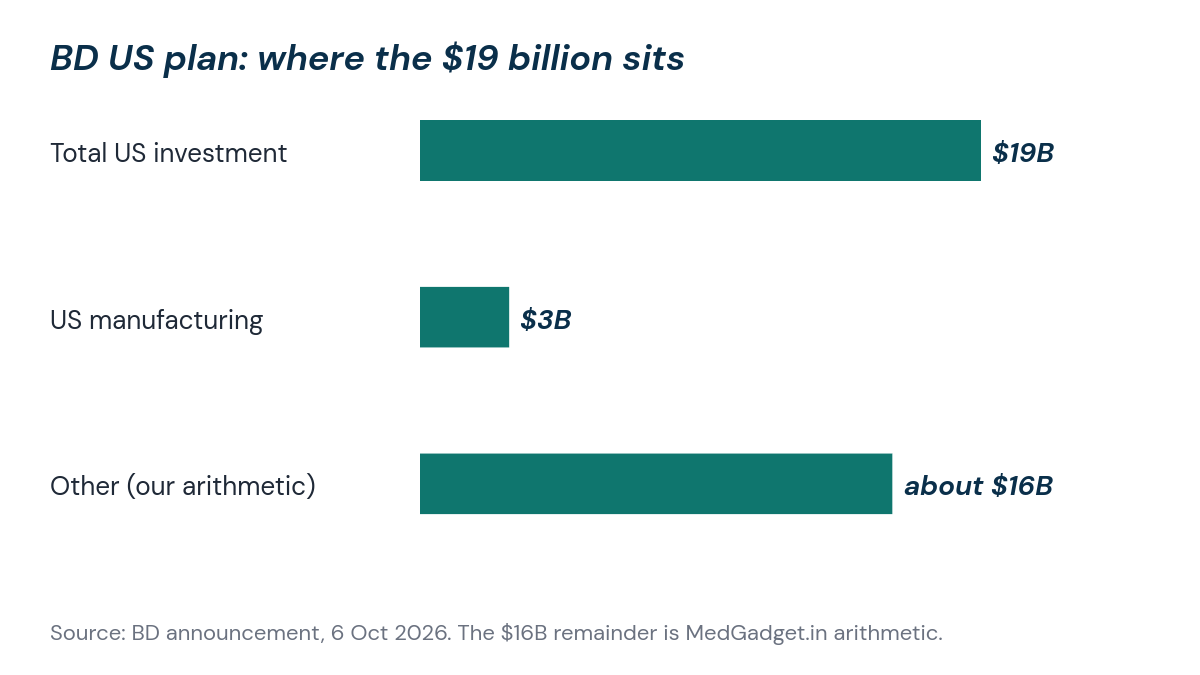
That distinction matters. Large corporate pledges often bundle new money with planned spending. BD had earlier committed to more than $2.5 billion in US manufacturing upgrades over five years, according to the company, so some of this plan likely builds on existing commitments. In our assessment, readers should treat the $19 billion as a ceiling-style headline and watch for site-level announcements that show what is genuinely incremental.
Why does the 80 percent target matter?
Syringes, needles, blood collection tubes and IV catheters are not glamorous, but they are used in an enormous share of care. BD says its consumables are involved in about 90 percent of hospital visits in the US. When a supply chain that broad depends on overseas plants, a tariff, a shipping disruption or a factory shutdown can quickly turn into a shortage on a hospital ward. The FDA tracks such problems on its medical device supply chain page.
Moving from the current domestic share toward 80 percent is therefore as much a resilience play as a trade play. The company did not disclose its current domestic percentage in the release we reviewed, so the size of the jump cannot be calculated.
Where will the money go?
BD named the following US sites as strategic production locations in its announcement. The company did not publish the amount or products for each site.
| Site | Location |
|---|---|
| Columbus | Nebraska |
| Broken Bow | Nebraska |
| Canaan | Connecticut |
| Añasco | Puerto Rico |
| Sandy | Utah |
| El Paso | Texas |
| Covington | Georgia |
| Sumter | South Carolina |
Nebraska has featured in earlier BD announcements, including a $110 million expansion in January 2026 that the company said would support about 120 jobs. A separate public statement by the US President linked the broader plan to more than $1 billion in Nebraska, but BD’s own release does not break the figure down by state, so we attribute that number to the President rather than to the company.
What does BD get in return?
The agreement offers BD relief from future Section 232 tariffs on covered products and inputs, subject to final scope and to BD achieving agreed milestones, according to the company. Section 232 allows the US government to impose tariffs on imports considered a national security concern, and an investigation into medical devices and related products began in September 2025. The tariff relief is conditional, which is the key phrase: if BD misses its milestones, the shield may not hold.
Chief executive Tom Polen framed the plan as strengthening America’s healthcare resilience. You can read the company’s account on its newsroom, and background on trade policy at the US Department of Commerce.
What it could mean for India and other suppliers
Our assessment, not a company claim: Indian manufacturers of syringes, needles and other single-use devices that export to the US should watch this closely. If domestic sourcing becomes a condition for tariff relief across the industry, buyers may prefer US-made volume, and imported products could face a harder pricing environment. On the other hand, US capacity takes years to build, and hospitals still need diversified supply, which keeps room for qualified overseas suppliers. India’s medical device sector is also pursuing its own self-reliance push, so the BD plan is a reminder of how competitive the global localisation race has become.
Supply chain risk is not only about tariffs. Our report on the Kusum plant strike in Sumy shows how physical disruption can remove capacity overnight, while our coverage of Axogen’s acquisition and the wider medical device news section tracks how companies are reshaping their footprints.
What we do not know
- Timeline: BD said “several years” but gave no completion date for each site.
- Jobs: the release did not give a company-wide employment figure.
- Prices: there is no statement on whether domestic production will change what hospitals pay.
- Final tariff scope: the covered products and inputs are subject to final definition.
Frequently asked questions
How much is BD investing in the US?
BD says it will invest $19 billion in the US over several years, including $3 billion focused on manufacturing expansion.
What does the 80 percent target refer to?
It refers to the share of BD’s essential medical consumables that would be supplied domestically after the planned expansion.
Which products are included?
The release highlights needles, saying all BD needles used in the US will be made domestically with American-made steel, and says production will rise by about 5 billion consumables a year.
Does BD escape tariffs under the deal?
The company says it receives relief from future Section 232 tariffs on covered products and inputs, subject to final scope and to meeting agreed milestones.
Is the $19 billion all new money?
Not necessarily. The statement does not separate new spending from existing plans, so that cannot be confirmed.
How we reported this
This article is based on BD’s announcement dated 6 October 2026 and official sources linked above. The $16 billion remainder and the 84 percent share are our own arithmetic. Statements about India are our assessment. Last updated 7 October 2026. This is general information and not investment advice.