

India is moving to put a cough syrup red warning on every bottle. The Drugs Consultative Committee (DCC), the advisory body that brings together the Centre and state drug regulators, has recommended that cough syrup labels carry a prominent red warning that the medicine must not be used in children below four years of age. The panel also wants labels to drop child-oriented imagery, such as pictures of infants, toddlers or toys, that could suggest the product is meant for young children. The recommendation is not yet law: it needs an amendment to the Drugs Rules, 1945.
Key Takeaways
- The recommendation: a red warning, in larger type, stating that cough syrup shall not be used in children below four years of age.
- The packaging rule: no pictures of infants, toddlers, toys or similar depictions that may suggest use in small children.
- Legal status: still a recommendation. It requires an amendment to Rule 96 of the Drugs Rules, 1945, and reports say further approvals are needed.
- What parents should do now: do not give cough or cold syrups to young children without a doctor’s advice.
- Open question: reports differ on the exact date of the DCC meeting, noted below.
What exactly did the DCC recommend?
According to reports of the committee’s decision, the DCC proposed a statutory warning under Rule 96 of the Drugs Rules, 1945, which governs what must appear on drug labels. The proposed text reads: “WARNING: Cough syrup shall not be used in children below 4 years of age.” It is to be displayed prominently in red with an increased font size so that it cannot be missed by a parent reading the bottle at home or a pharmacist at the counter.
The second part is just as notable. Manufacturers would be barred from using pictures of infants, toddlers, toys or similar depictions that may suggest use in small children. The committee’s reasoning, as reported, is that such imagery creates confusion about who the product is for. Parents often judge a medicine by its packaging, and a teddy bear on a bottle sends a different message from a block of warning text.
When did the committee meet?
Here is where accounts diverge. One report places the committee’s 70th meeting on 18 September 2026, in hybrid format at the CDSCO headquarters in New Delhi. Another gives 29 September 2026 for the recommendation. We could not locate the official minutes on the regulator’s website at the time of writing, so we cannot say which date is correct. Readers should check the Central Drugs Standard Control Organisation (CDSCO) site for the published minutes.
Earlier reports, dated around 19 to 22 September, described the proposal as placed before the DCC for deliberation and said it also floated a picture of school-age children on the label to reinforce that the product is for older children. The latest reports instead describe a ban on imagery suggesting very young users. Whether the school-age picture was kept is not clear from the material we reviewed.
How does this fit with earlier restrictions?
The label proposal is the latest in a series of steps on children and cough-and-cold medicines. The timeline, as reported, is shown below.
| When | What happened |
|---|---|
| October 2025 | The Directorate General of Health Services (DGHS) advised against prescribing cough and cold medicines to children below 2 years |
| April 2026 | A CDSCO internal technical committee discussed a complaint about continued prescribing to infants and made recommendations |
| 22 August 2026 | The Centre restricted fixed-dose combinations containing chlorpheniramine maleate and phenylephrine in children below 4 years, with a mandatory warning |
| September 2026 | The DCC took up the label proposal for cough syrups; recommendation reported in early October |
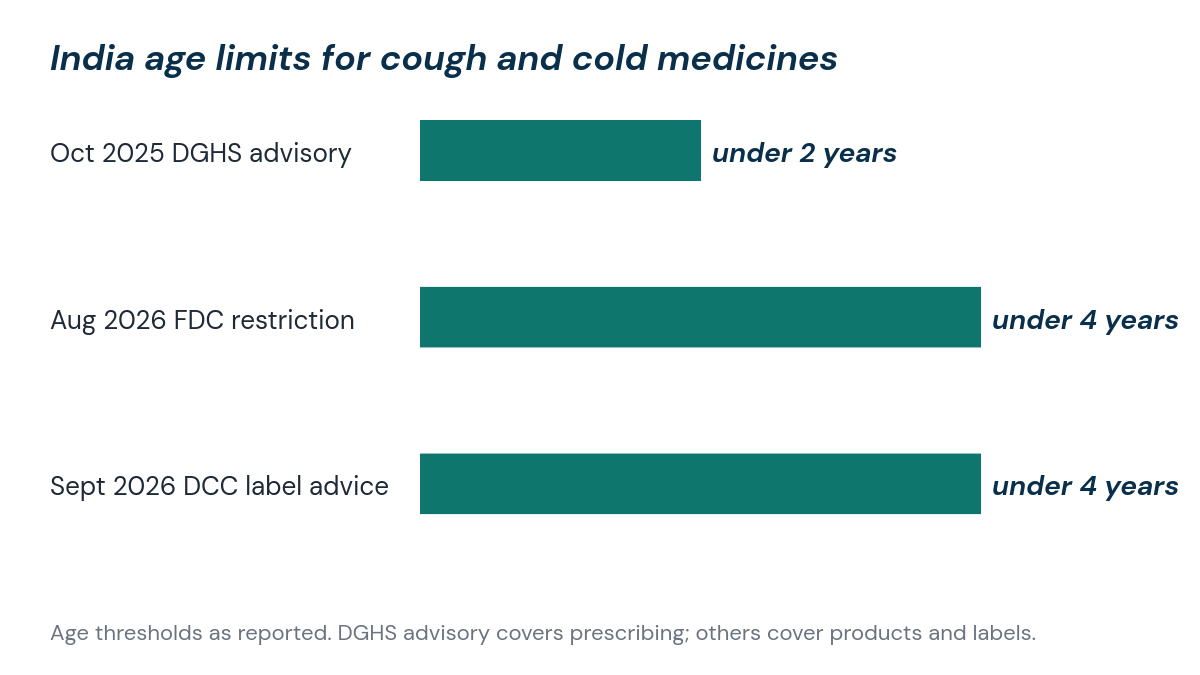
Note the shift in age. The 2025 advisory concerned children under two, while the August 2026 restriction and the new label recommendation both use four years. That is a tougher line, and it reflects the view that very young children are less able to tolerate such medicines and that safer alternatives exist. The August order was issued under Section 26A of the Drugs and Cosmetics Act, 1940, following expert committee and Drugs Technical Advisory Board review, as reported. You can find regulatory notices and advisories on the CDSCO website and the DGHS portal.
Is the red warning mandatory yet?
No. A DCC recommendation is advice to the government, not a binding rule. For the label to become compulsory, the Drugs Rules, 1945 must be amended. Reports say the proposal still needs approval from the Drugs Technical Advisory Board (DTAB), followed by a draft notification, a public comment period and publication in the Gazette, a process that could take a year or longer. Until then, manufacturers are not legally required to print the new warning, although some may do so voluntarily.
What does it mean for manufacturers and pharmacies?
For cough syrup makers, the practical impact will be a redesign of labels and cartons, and a review of marketing visuals. In our assessment, the imagery ban could affect brands that have long used cartoon characters or child-friendly mascots, particularly on products sold over the counter. Pharmacies may need to update counselling practices and ensure stock carries the correct labelling once the rule is notified.
The change also comes as India continues to tighten oversight of drug quality and safety, a theme we have covered in our report on the Maharashtra FDA licence cancellation and in our wider pharmaceutical news section.
What should parents do in the meantime?
The warning is aimed at a familiar habit: reaching for a cough syrup the moment a small child starts coughing. Most coughs in children are caused by viral infections and settle on their own. The following general precautions are widely recommended by paediatricians, but your own doctor should guide any decision.
- Do not give cough or cold syrups to a child below four years unless a doctor has specifically prescribed one for that child.
- Never use adult medicines for children, and never guess doses.
- Check the active ingredients on the label and avoid doubling up on products that contain the same drug.
- Seek medical help promptly if a young child has trouble breathing, a persistent high fever, a cough that lasts more than a few days or looks unusually drowsy.
- Keep all medicines out of children’s reach.
Our assessment
In our assessment, the recommendation is sensible but its effect will depend on enforcement. A warning label helps only when the product is sold with its original packaging and when sellers and prescribers respect it. The more significant test is whether regulators monitor imagery claims and whether the amended rule is notified without long delay. Until the final text is published, readers should treat the details above, including the exact wording, as the committee’s recommendation and not a final rule.
Frequently asked questions
What did India’s Drugs Consultative Committee recommend about cough syrups?
It recommended a prominent red warning that cough syrup shall not be used in children below four years of age, and a ban on child-oriented imagery on labels.
Is the cough syrup red warning mandatory now?
No. It requires an amendment to the Drugs Rules, 1945, and further approvals, so it is not yet legally binding.
Which rule would be amended?
Reports say Rule 96 of the Drugs Rules, 1945, which deals with the manner of labelling medicines.
Why are pictures of toys and toddlers being restricted?
The committee reportedly felt that such images can suggest the product is suitable for small children and cause confusion.
Can I give cough syrup to a child under four?
Only if a doctor has prescribed it for that child. Otherwise avoid it and consult a paediatrician.
How long will the change take?
Reports suggest the process could take a year or longer, because of approvals and the notification procedure.
How we reported this
This article is based on published reports of the DCC recommendation and of earlier government advisories and notifications, supplemented by the regulator’s website links above. We could not access the official DCC minutes, so the meeting date and exact wording are as reported and differ between accounts. Statements marked as our assessment are opinion. Last updated 7 October 2026. This article is for general information and is not medical advice; consult a doctor for any child’s health concern.