

For people whose skin turns into raised, itchy welts after a scratch or the rub of a waistband, there has never been a medicine made for their condition. That changed on 7 October 2026. In a symptomatic dermographism treatment approval, the US Food and Drug Administration approved Novartis’s oral drug remibrutinib (Rhapsido) for adults whose symptomatic dermographism is not controlled by H1 antihistamines. It is the first treatment cleared for the condition, and it follows positive Phase III results.
Key Takeaways
- Approval: FDA approved Rhapsido (remibrutinib) on 7 October 2026 for adults with symptomatic dermographism inadequately controlled by H1 antihistamines.
- A first: it is the first treatment approved for symptomatic dermographism, and the only prescription medicine approved for both symptomatic dermographism and chronic spontaneous urticaria, per the company.
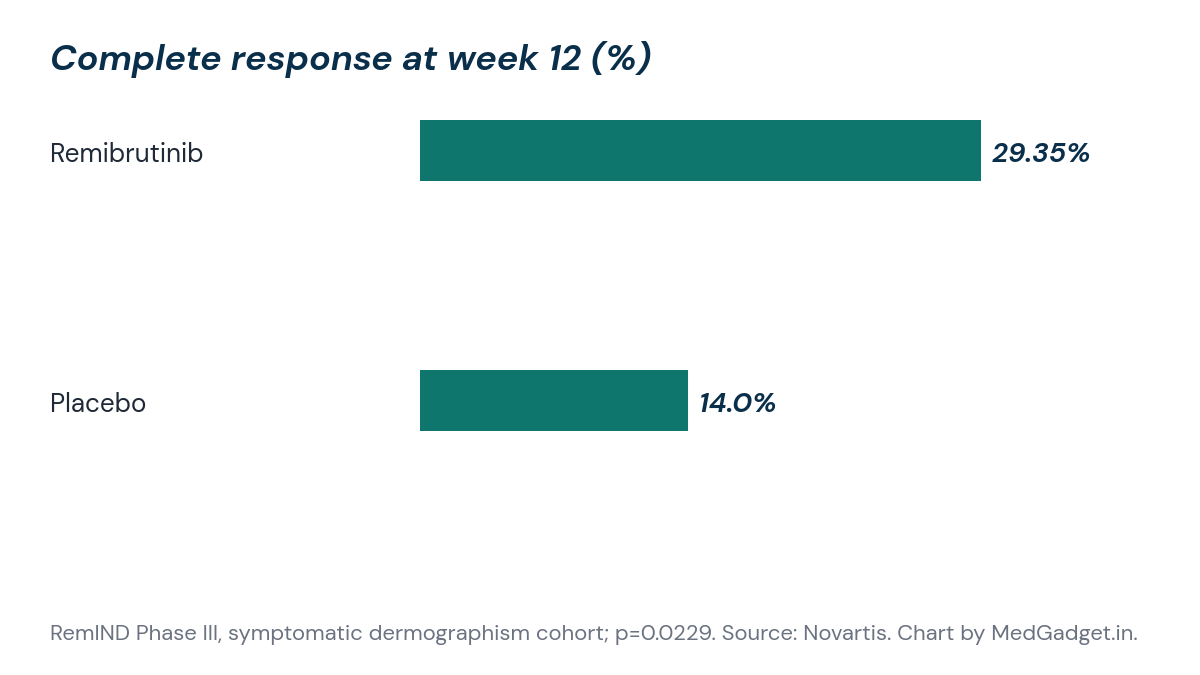
- Phase III data: at week 12, 29.35 percent of patients on remibrutinib had a complete response, versus 14.0 percent on placebo (p=0.0229).
- How it works: an oral, highly selective Bruton tyrosine kinase (BTK) inhibitor that blocks a pathway involved in histamine release.
- Fine print: most patients did not reach a complete response in the trial, so expectations should be realistic.
What is symptomatic dermographism?
Symptomatic dermographism, also called dermatographia or “skin writing,” is a form of chronic inducible urticaria, a type of chronic hives. Light pressure, rubbing or scratching makes red, raised, itchy welts appear within minutes. The trigger is physical, so everyday activities such as dressing, bathing or carrying a bag can set it off. Antihistamines are the usual first treatment, but many patients stay symptomatic, which is the gap this approval targets. General information on hives is available at MedlinePlus.
The articles we reviewed do not give a prevalence figure for the condition, so we do not quote one. The approval signals that regulators view the unmet need as real.
What did the Phase III RemIND trial show?
The approval is based on the RemIND study (NCT05976243), which compared remibrutinib with placebo in patients who remained symptomatic despite second-generation H1 antihistamines. Efficacy was measured as complete response, defined using the Total Fric Score, a measure of itch and welts after a standardised friction test.
| Measure | Remibrutinib | Placebo |
|---|---|---|
| Complete response at week 12 | 29.35% | 14.0% |
| Statistical significance | p=0.0229 | Not applicable |
| Time to first responses | As early as week 2 | Not stated |
By our own arithmetic, the placebo-adjusted difference is about 15 percentage points. The trial also means that roughly 70 percent of patients on the drug did not reach a complete response at week 12. That is not a failure: partial improvement may still matter to patients, and the release material we saw does not detail partial responses. But it is a reminder that a statistically significant result is not the same as a cure.
Is remibrutinib safe?
Novartis says the safety profile through week 24 was consistent across symptomatic dermographism and chronic spontaneous urticaria. Common adverse events included nasal congestion, sore throat, runny nose, bleeding, headache, nausea and abdominal pain. Bleeding appears on that list because BTK inhibitors can affect platelet function, so patients who take blood thinners or have bleeding disorders should discuss risks with their doctor. Dose and schedule were not specified in the coverage we reviewed; the prescribing information on the Novartis website is the authority.
Why does this approval matter beyond one condition?
Rhapsido was first approved on 30 September 2025 for adults with chronic spontaneous urticaria still symptomatic on antihistamines. This second indication extends it to the two most common forms of chronic hives, as Novartis’s US president Victor Bultó put it. For dermatology, the story is also about a drug class: BTK inhibitors, long associated with blood cancers, are moving into allergy and immune-mediated skin disease. Novartis says remibrutinib is also being studied in food allergy and hidradenitis suppurativa, and that RemIND also looked at cold and cholinergic urticaria, with plans to submit the full dataset to health authorities where appropriate.
For a dermatologist, a second approved indication also simplifies practice. A patient who has both spontaneous hives and hives triggered by friction, which is not unusual in chronic urticaria clinics, could in principle be treated with one oral medicine instead of juggling separate approaches. Whether that proves true in everyday care will depend on how insurers cover the drug, a question the company has not yet answered publicly.
The company also reported positive topline results for remibrutinib in relapsing multiple sclerosis in the REMODEL-1 and REMODEL-2 Phase III trials, with fewer relapses and slower disability progression than teriflunomide and no liver safety signals. Those are company-reported and separate from this approval.
What patients and advocates said
Giselle Mosnaim, a lead RemIND investigator at the University of Chicago Pritzker School of Medicine, said remibrutinib offers, for the first time, an approach to treatment specifically for patients with symptomatic dermographism. Kristen Willard of the patient group We CU said people living with the condition deserve treatment options developed specifically for it. Both statements reflect how long the community has relied on antihistamines taken off-label at higher doses.
What this means for you
- Talk to a dermatologist or allergist if antihistamines have not controlled your hives.
- Tell your doctor about all medicines, especially anticoagulants, before starting a BTK inhibitor.
- Track triggers and symptoms with photos; it helps assess response.
- Ask about cost and insurance coverage, which have not been disclosed in the material we reviewed.
More drug news is available in our pharmaceutical section, including our report on the EPCORE DLBCL-2 trial.
Frequently asked questions
What did the FDA approve on 7 October 2026?
Rhapsido (remibrutinib) for adults with symptomatic dermographism inadequately controlled by H1 antihistamines.
Is it the first approved treatment for symptomatic dermographism?
Yes, according to the company and the reports we reviewed.
How effective was remibrutinib in the trial?
29.35 percent had a complete response at week 12, compared with 14.0 percent on placebo.
Is it a chronic hives clinical trial drug or an approved one?
It is approved for chronic spontaneous urticaria (since September 2025) and now symptomatic dermographism, and still being studied in other conditions.
Is remibrutinib taken by mouth?
Yes. It is an oral BTK inhibitor.
How we reported this: this article is based on the approval and Novartis communications reported on 7 October 2026, plus public health references linked above. Efficacy and safety data are company-reported. The 15-point difference and the 70 percent non-response figure are our own arithmetic. Statements marked as our assessment are opinion. Last updated 8 October 2026. This is general information, not medical advice.