

The tovinontrine Phase 2 trial results, presented on 11 October 2026, show an unusual pattern: the lowest doses of this experimental heart failure drug lowered a key blood marker, while the highest dose did not. Cardurion Pharmaceuticals reported the data in a late-breaking session at the Heart Failure Society of America (HFSA) annual meeting in Phoenix. In the main study, 529 people with heart failure with reduced ejection fraction took one of three doses of tovinontrine or a placebo for 12 weeks.
The results are an early signal, not proof. The study measured a biomarker, not deaths or hospital stays, and the company has not published the size of the effect. This report sets out what was found, why the dose pattern matters and what must happen before anyone can say the drug helps patients.
Tovinontrine Phase 2 trial: the results at a glance
- Drug: tovinontrine (CRD-750), an oral PDE9 inhibitor.
- Main study (Cycle-1REF): 529 people with heart failure and reduced ejection fraction (HFrEF), taking background standard therapy.
- Doses: 2.5 mg, 25 mg or 50 mg twice daily, against placebo, for 12 weeks.
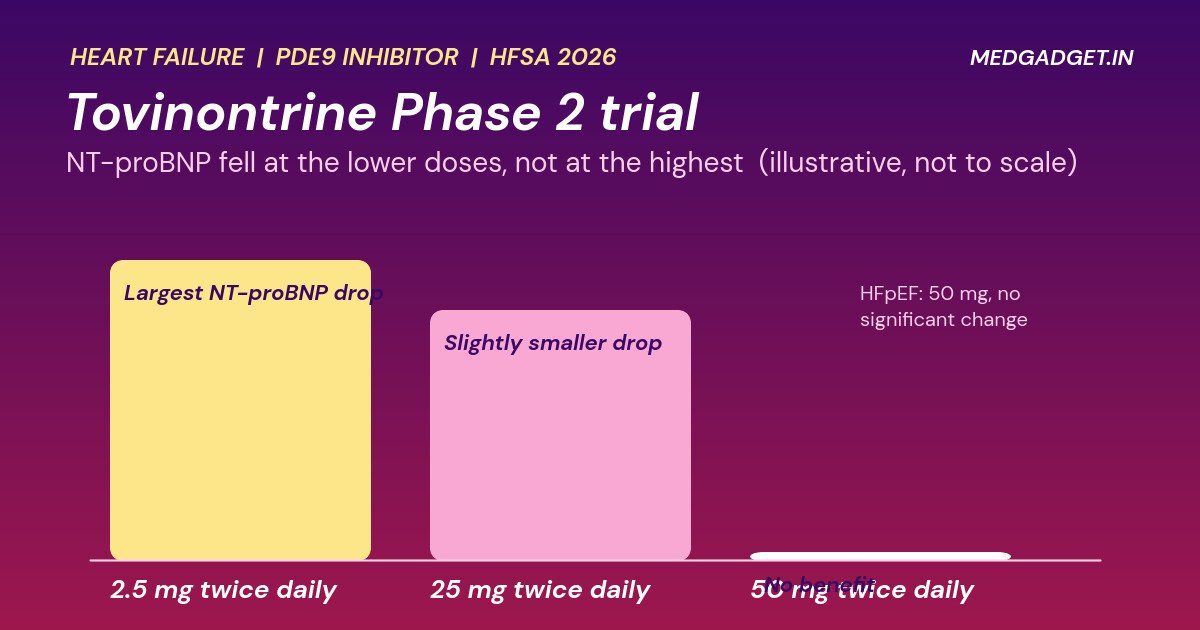
- Result: the biggest NT-proBNP reduction was at 2.5 mg, a slightly smaller one at 25 mg, and no benefit at 50 mg.
- Second study (Cycle-2PEF): 277 people with preserved ejection fraction (HFpEF) took 50 mg twice daily, and NT-proBNP did not change significantly.
- Safety: described by the company as favourable at all doses, with no event rates given.
What NT-proBNP tells us in the tovinontrine Phase 2 trial
NT-proBNP is a protein the heart releases when its walls are stretched. Doctors use it as a blood marker of how much strain the heart is under, and lower levels are generally linked to better outcomes in heart failure. A drug that lowers it is therefore of interest, but a falling marker does not guarantee fewer hospital stays or deaths. Several drugs have moved biomarkers without improving outcomes, which is why this is called a proof of concept.
The company says reductions appeared as early as week 2 and held up, and that brain natriuretic peptide (BNP) also fell. It reports that plasma and urinary cGMP rose, which it takes as evidence the drug is hitting its target. The National Heart, Lung, and Blood Institute offers general background on heart failure.
The dose puzzle in the tovinontrine Phase 2 trial
Most drugs do more at higher doses, up to a point. Here, the lowest dose looked best and the highest did nothing. By our arithmetic, the highest dose was 20 times the lowest, and 25 mg was ten times the lowest. The company suggests an explanation: very high levels of cGMP, the signalling molecule the drug raises, may trigger a counter-regulatory response that cancels the benefit. It cites published studies and internal analysis for this idea, but gives no references, so we treat it as a hypothesis.
An inverted dose response makes late-stage planning harder, because the right dose must be chosen with care. The company has not said which dose it would take forward. It said it plans to keep developing tovinontrine as a possible first-in-class add-on therapy, and no Phase 3 design or timing has been announced.
What the tovinontrine Phase 2 trial did not show
- No effect sizes: the percentage reductions, p-values and confidence intervals were not reported.
- No clinical outcomes: the trial did not measure hospitalisations or survival.
- No safety numbers: adverse-event, blood-pressure and discontinuation rates were not released.
- No arm sizes: the 529 participants are not broken down by dose group.
- One dose in HFpEF: only 50 mg was tested, so the company’s hope for lower doses in HFpEF is untested.
- No peer review: the data came from a conference presentation and a company release.
By our count, the two studies together randomised 806 people. The announcement also describes itself in two ways, saying the data “will be presented” in a headline and “presented today” in the text. We take the latter as correct.
How the drug in the tovinontrine Phase 2 trial is meant to work
The heart makes natriuretic peptides that help it unload fluid and relax. They work by raising cGMP inside heart cells, and the enzyme PDE9 breaks cGMP down. Blocking PDE9 should keep cGMP higher and strengthen that protective signal. The company says PDE9 is raised in chronic heart failure and describes itself as the first to bring a PDE9 inhibitor into clinical development for this use, which is its claim and which we have not verified.
Our assessment of the tovinontrine Phase 2 trial
In our assessment, the tovinontrine Phase 2 trial is a cautious win. Two of three doses in the larger study moved the marker, the effect arrived quickly and the result agrees with the drug’s proposed mechanism. Against that, the failure at the top dose in both studies is real, the missing numbers prevent any judgement of how large the effect is, and the HFpEF study was negative at the only dose tested. Readers should treat it as a reason for a larger trial, not a reason to expect a new treatment soon. There is no India-specific data in the release, and the drug is not available anywhere.
For related heart and kidney drug news, see our report on the FDA’s expanded Kerendia approval and on the global artificial organs market, or browse more pharmaceutical news.
What to watch after the tovinontrine Phase 2 trial
- The full data, including effect sizes, safety and dose groups.
- A peer-reviewed publication of both studies.
- The dose and design chosen for any Phase 3 trial, and whether it measures hospitalisations or survival.
- New HFpEF data at lower doses, and entries on ClinicalTrials.gov.
Frequently asked questions
What did the tovinontrine Phase 2 trial find?
Two of three tested doses reduced NT-proBNP in people with HFrEF, with the largest reduction at the lowest dose, while the highest dose showed no benefit.
Did the tovinontrine Phase 2 trial work in HFpEF?
Not at the dose tested. At 50 mg twice daily, NT-proBNP did not change significantly in the 277-person study.
Does the tovinontrine Phase 2 trial show it saves lives?
No. It measured a blood marker over 12 weeks, not hospital stays or deaths.
What is the PDE9 inhibitor in the tovinontrine Phase 2 trial?
A drug that blocks the PDE9 enzyme to raise cGMP and strengthen natriuretic peptide signalling in the heart.
Is tovinontrine approved?
No. It is experimental, and no Phase 3 trial has been announced.
How we reported this: we relied on the company’s release of 11 October 2026 and on coverage of the same data. Results are company-reported, were presented at a conference and are not peer reviewed. Figures labelled as ours are our own calculations. Last updated: 12 October 2026. This article is news reporting and not medical advice.
[…] Hypertension Study: 2 New Post Hoc Analyses Tovinontrine Phase 2 Trial: Lower Doses Cut NT-proBNP NEET PG Counselling 2026: Round 1 Registration Oct 12-21 Emcure Pharmaceuticals Merger 2026: 2 […]
[…] needed a closer read, see our reports on the idiopathic pulmonary fibrosis Phase 3 trial, the tovinontrine Phase 2 trial in heart failure and the aprocitentan hypertension study, or browse more pharmaceutical […]
[…] design, although still not randomised. For related cardiovascular reading, see our report on tovinontrine in heart failure with reduced ejection fraction and on new aprocitentan hypertension analyses, plus our wider medical device coverage. General […]