

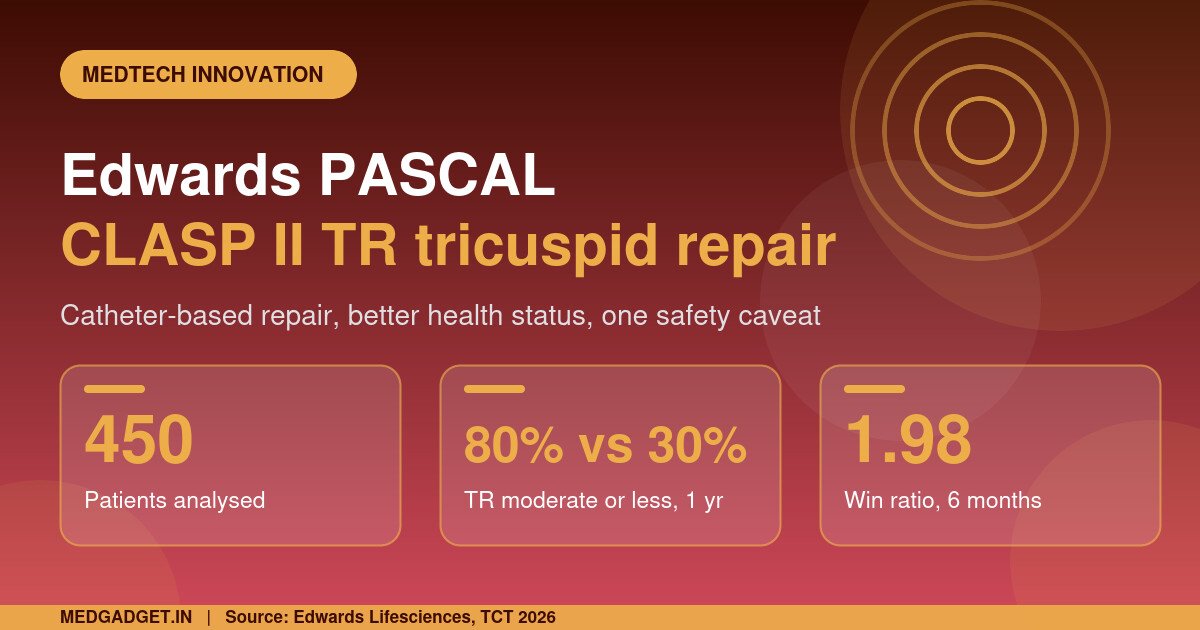
The Edwards PASCAL CLASP II TR trial, presented at TCT 2026 and announced by Edwards Lifesciences on 2 November 2026, reports that a catheter-based repair device improved health status in patients with severe tricuspid regurgitation compared with medical therapy alone. In the randomised study of 450 patients, the PASCAL system plus optimal medical therapy beat medical therapy on the primary endpoint at six months, and benefits were reported at one year. One safety figure, all-cause mortality, was numerically higher with the device, though not statistically significant.
Key takeaways from the Edwards PASCAL CLASP II TR trial
- Design: 450 symptomatic patients with severe or greater tricuspid regurgitation despite medical therapy, randomised 2:1 to PASCAL plus medical therapy (302) or medical therapy alone (148).
- Primary result (six months): win ratio 1.98 (95% CI 1.47 to 2.67; p below 0.001), driven mainly by health status on the KCCQ-OS questionnaire.
- Edwards reports a clinically significant 18-point KCCQ improvement, sustained to one year.
- At one year, tricuspid regurgitation was reduced to moderate or less in 80% of the PASCAL group versus 30% of controls.
- All-cause mortality was 8.8% with PASCAL versus 4.6% in controls (p=0.125, not significant); heart-failure hospitalisation was 13.2% versus 12.9%.
- The trial title says one-year results, but the primary endpoint was assessed at six months; the one-year data are additional.
Why tricuspid regurgitation needs new options
The tricuspid valve sits between the right atrium and right ventricle. When it does not close properly, blood leaks backwards, a condition called tricuspid regurgitation. Severe leakage can cause fatigue, swelling and breathlessness, and can strain the heart and liver. Medicines such as diuretics relieve symptoms but do not fix the valve, and surgery is not suitable for every patient, especially those at higher surgical risk. The trial enrolled people at intermediate or high surgical risk who remained in NYHA functional class II to IVa. General information on valve disease is available from the American Heart Association.
How catheter-based repair works
The PASCAL system is delivered through a vein by catheter, so the chest does not have to be opened. The device is designed to clip together parts of the valve leaflets, reducing the gap through which blood leaks. Because it is a repair and not a replacement, the patient’s own valve tissue is kept. This is a general description; Edwards’ own materials describe the device in detail.
The numbers
| Measure | PASCAL plus medical therapy | Medical therapy alone |
|---|---|---|
| Patients analysed | 302 | 148 |
| TR moderate or less at 1 year | 80% | 30% |
| Tricuspid interventions | 5.5% | 15.8% |
| All-cause mortality | 8.8% | 4.6% (p=0.125) |
| Heart-failure hospitalisation | 13.2% | 12.9% (p=0.831) |
The win ratio is a method that ranks patients against each other across a hierarchy of outcomes. The material we reviewed does not describe the hierarchy or give the KCCQ scores for each group, so we cannot say how much each component contributed beyond the statement that health status drove the result.
The safety picture
Adverse events were adjudicated. The reported composite major adverse event rate was 6.9% at 30 days and 20.1% at one year, and single leaflet device attachment occurred in 3.4% at 30 days and 4.8% at one year; the figures were not split by treatment arm in the material we saw. Edwards described low adverse event rates at 30 days. The mortality difference of 8.8% versus 4.6% was not statistically significant, but it is numerically higher with the device, and a trial of this size cannot rule out a true difference. Readers should look at the full publication for survival curves and causes of death.
Timeline
- 2020: Edwards reports a CE Mark for PASCAL in tricuspid use (company statement, not independently verified by us).
- October 2026: Edwards says it received FDA approval for tricuspid repair (company statement; we have not checked the FDA record).
- 2 November 2026: CLASP II TR results presented at TCT 2026.
Market context: transcatheter heart valves
Acumen Research And Consulting does not publish a tricuspid-specific report, so we cite its Transcatheter Heart Valve Replacement Systems Market report as adjacent. It values the global market at USD 5.1 billion in 2022 and projects USD 14.7 billion by 2032, a compound annual growth rate of 11.4% for 2023 to 2032. North America was about USD 1.9 billion, Asia-Pacific is projected to grow at over 12%, and transcatheter aortic valve replacement accounted for about USD 4.3 billion.
The report is dominated by aortic valve replacement, was last updated in February 2024, mislabels the tricuspid valve as the left-side valve and refers to coronary valves. Our own check suggests that 11.4% compounded for ten years from USD 5.1 billion gives about USD 15.0 billion, slightly above the stated figure. We use it only as an indicator of the wider category.
Our analysis
In our assessment, CLASP II TR is an important innovation story because it provides randomised evidence for a catheter-based option in a group with few good choices, and the improvement in how patients feel is clinically meaningful. The same data show that the case is not closed. The primary result is about health status, which is patient-reported and can be influenced by knowing the treatment. Survival and hospitalisation did not improve, and mortality was numerically higher. The balanced reading is that PASCAL can improve symptoms and reduce leakage, but longer follow-up is needed for survival.
What is not disclosed
- The win-ratio hierarchy and KCCQ scores by arm.
- Adverse event rates split by treatment group.
- The cause of death in each arm.
- Blinding procedures.
- The date and precise terms of the FDA approval.
Risks and caveats
- Mortality was numerically higher with PASCAL, though not significantly.
- The primary endpoint is at six months, not one year.
- Data are from a company announcement and conference presentation.
- This is not medical advice.
What to watch next
- The full journal publication.
- Longer follow-up on survival.
- Guideline and coverage decisions.
- Competing tricuspid devices.
General background
Company information is at Edwards Lifesciences. Related coverage: Boston Scientific’s SIMPLAAFY trial and Abbott’s SonicForce trial. More in our Medical Device section.
Questions readers are asking about the Edwards PASCAL CLASP II TR trial
Does PASCAL help patients feel better?
The trial reports a clinically significant improvement in health status on the KCCQ, per Edwards.
Does it help patients live longer?
That is not shown. Mortality was 8.8% versus 4.6%, not statistically significant but numerically higher with PASCAL.
Is PASCAL approved for the tricuspid valve?
Edwards says the FDA approved it in October 2026; we have not independently verified this.
FAQ
What does KCCQ measure?
Health status in heart failure, including symptoms and quality of life.
What is a win ratio?
A method that compares patients pairwise across ranked outcomes.
What is the control treatment?
Optimal medical therapy alone.
How we reported this: details come from Edwards Lifesciences’ announcement of 2 November 2026 and a conference report; market figures are attributed to Acumen Research And Consulting. Last updated 4 November 2026. This is news reporting and not medical advice.