

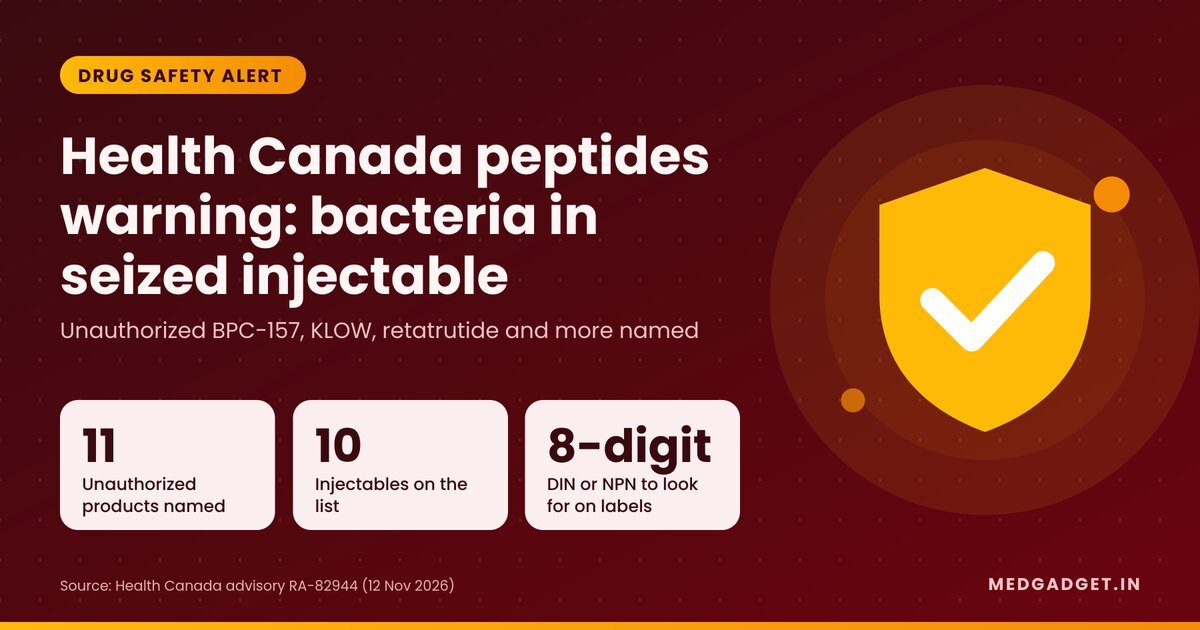
A Health Canada peptides warning issued on November 12, 2026 tells consumers not to inject or swallow unauthorized peptide products after laboratory tests found Sphingomonas aquatilis/melonis bacteria in an injectable peptide seized from Sage & Summit Wellness Co. in Ottawa. The regulator named 11 products, including BPC-157, a “KLOW” blend and the investigational obesity drug retatrutide, and said the store has agreed to stop selling peptides in-store and online.
The advisory matters well beyond one shop. Injectable “wellness” peptides are among the fastest-growing grey-market health products, sold online with “research use only” labels to buyers chasing recovery, weight loss or anti-ageing. Here is what was found, which products were listed, and how to recognise an infection early.
Key takeaways on the Health Canada peptides warning
- Bacteria (Sphingomonas aquatilis/melonis) were found in an injectable peptide seized after a consumer complaint.
- Ten unauthorized injectables and one oral capsule product were named; all were sold in Ontario and online.
- Contaminated injectables can cause serious infection, hospitalisation and, in severe cases, sepsis.
- A “For Research Purposes Only” label does not make a product legal or safe, Health Canada says.
- Authorised products in Canada carry an eight-digit DIN or NPN; none of the listed products had been assessed for safety, efficacy or quality.
What the lab found and how the case started
According to the Health Canada advisory (RA-82944), inspectors acted on a complaint that the Preston Street store was selling unauthorized peptides. Products were seized, and testing of an injectable vial detected Sphingomonas, a group of environmental bacteria common in water and soil. These organisms rarely harm healthy people, but injected directly under the skin or into muscle they can cause local abscesses and, in people with weakened immunity, bloodstream infections.
The more important lesson is what contamination implies: a product that should be sterile was not made, filled or stored under sterile conditions. Health Canada lists other quality failures typical of the category, including wrong or missing active ingredient, unlisted substances, solvents, metals, particles and endotoxins, and incorrect labelling.
The 11 products named in the advisory
| Product as labelled | Form | Context |
|---|---|---|
| BPC-157 | Injectable | Experimental “healing” peptide; not authorised as a drug in Canada |
| Healing Blend (BPC-157, TB-500) | Injectable | Two-peptide recovery blend |
| KLOW (BPC-157, TB-500, GHK-Cu, KPV) | Injectable | Four-peptide blend marketed online |
| Retatrutide | Injectable | Investigational Lilly obesity drug; not authorised for sale |
| Tesamorelin | Injectable | Growth-hormone-releasing peptide; this product unauthorised |
| hCG | Injectable | Hormone; this product unauthorised |
| MOTS-C | Injectable | Mitochondrial peptide sold for “metabolic” use |
| SELANK | Injectable | Marketed for anxiety and focus |
| SEMAX | Injectable | Marketed for cognition |
| MELANOTAN-1 | Injectable | Tanning peptide |
| PURE BPC-157 | Oral capsules | Unauthorised oral product |
Beyond infection, Health Canada warns that unauthorized peptides may cause hormonal imbalance, mood swings, blood sugar swings, liver or kidney damage, blood clots and the growth of cancerous tumours. Retatrutide stands out on the list: it is a potent triple-hormone agonist still in clinical development, and buyers have no way to verify what dose, if any, is in an unregulated vial. We covered the regulated side of the GLP-1 market in our report on Lilly’s orforglipron approval in China.
Warning signs after injecting a peptide
Health Canada advises immediate medical attention for anyone who injected an unauthorized peptide and develops any of the following:
- Redness, swelling or pain at the injection site
- Fever or chills
- Feeling generally unwell after use, which also warrants seeing a doctor
Tell the clinician exactly what was injected and bring the vial if possible, since lab identification of the organism guides antibiotic choice. People with diabetes, cancer, HIV or other causes of weakened immunity face higher risk.
Why “research use only” labels do not protect buyers
Some seized vials carried “For Research Purposes Only” labels, a tactic sellers use to imply the product is outside drug rules. Health Canada rejects that reading: in Canada, injectable peptides are generally regulated as prescription drugs, should only be used under a licensed health professional, and selling unauthorized health products is illegal. The agency says it will keep seizing products and is working with the Canada Border Services Agency to stop shipments at the border.
Why it matters for readers in India and elsewhere
The same products are sold globally through websites and social media, and much of the world’s peptide manufacturing capacity sits in Asia, including India’s fast-growing contract manufacturing sector, as our story on Shilpa CDMO’s peptide expansion shows. Regulated manufacturers work under sterile-production rules; grey-market sellers do not. In the United States, regulators have recently allowed compounding pharmacies to prepare a short list of peptides under prescription, which is different from buying unlabelled vials online.
The practical checklist is the same everywhere: buy injectables only on prescription from a licensed pharmacy, look for the national registration number on the label, avoid anything marked for research use, and dispose of unauthorized products through a pharmacy or hazardous-waste service. More coverage is in our Pharmaceutical section.
FAQ
Is BPC-157 legal in Canada?
BPC-157 products named in this advisory are unauthorized, and Health Canada says selling unauthorized health products is illegal. Injectable peptides are generally regulated as prescription drugs.
What bacteria did Health Canada find in the peptides?
Sphingomonas aquatilis/melonis, found in an injectable peptide seized from Sage & Summit Wellness Co. in Ottawa.
What should I do if I used one of these peptides?
Stop using it. Seek medical care if you feel unwell, and urgently if you have redness, swelling or pain at the injection site, fever or chills. Report side effects to Health Canada.
How can I tell if a peptide product is authorised in Canada?
Look for an eight-digit Drug Identification Number (DIN) or Natural Product Number (NPN) on the label, and buy only from licensed pharmacies.
Sources: Health Canada public advisory RA-82944 (November 12, 2026); Reuters. No Acumen Research and Consulting report was directly relevant to this safety advisory. This article is for information only and is not medical advice. Last updated November 13, 2026.