

The PRIP scheme has approved about ₹1,600 crore in financial assistance for 41 pharmaceutical and MedTech research projects in its first call, the Department of Pharmaceuticals said on September 30, 2026. The projects are expected to draw another ₹3,020 crore in private investment, bringing total planned R&D spending to about ₹4,620 crore.
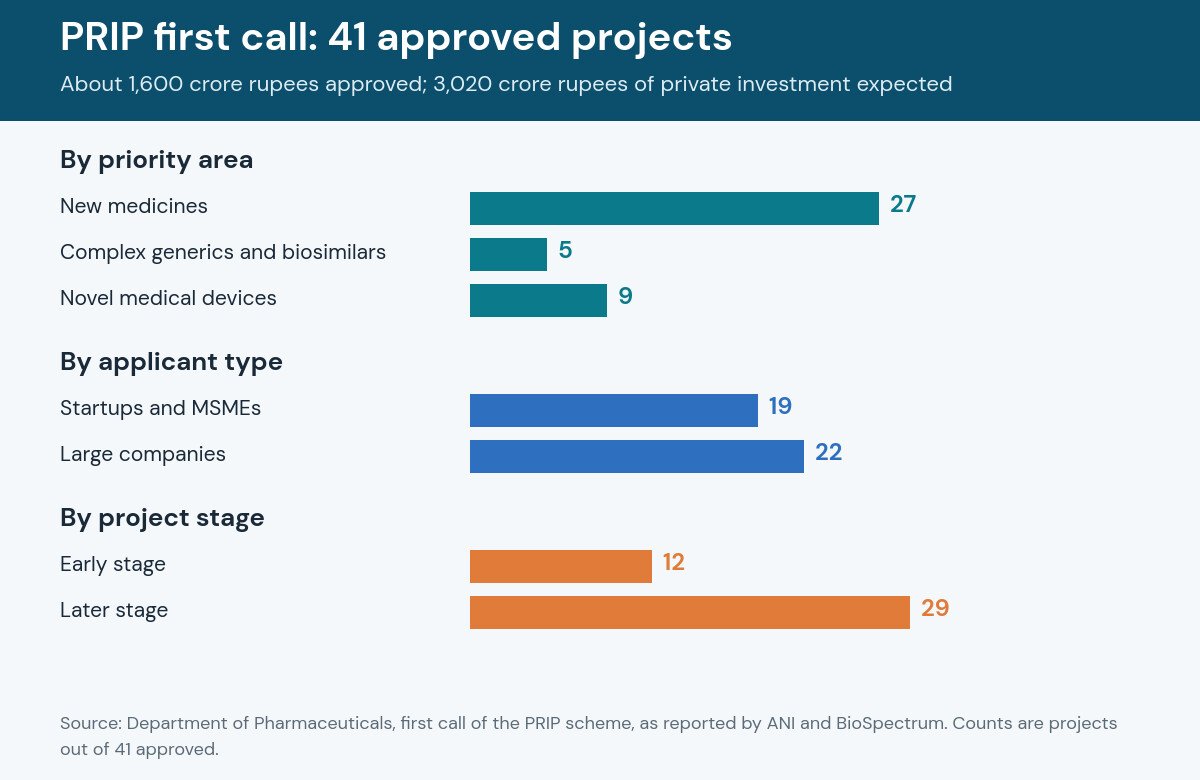
PRIP, short for Promotion of Research and Innovation in Pharma MedTech Sector, is a ₹5,000 crore scheme meant to move India’s industry from cost-based growth toward innovation-led research. According to ANI, 27 of the 41 projects are in new medicines, five are in complex generics and biosimilars, and nine are in novel medical devices.
Key Takeaways: PRIP Scheme First-Call Approvals
- 41 projects were approved with about ₹1,600 crore of financial assistance, and they are expected to attract ₹3,020 crore more from private investors.
- Total R&D investment across the projects is about ₹4,620 crore. Twelve projects are at an early stage and 29 at a later stage.
- Nineteen projects come from startups and MSMEs and 22 from large companies, including Biocon, Bharat Biotech, Sun Pharma, Wockhardt, Zydus and Mankind Pharma.
- Remaining first-round applications are still under evaluation, with more results due over the coming month.
- A new track offers startups and MSMEs up to ₹50 crore per project for early-stage novel drug discovery, with at least 25% co-funding from institutional investors.
What Is the PRIP Scheme?
The Promotion of Research and Innovation in Pharma MedTech Sector (PRIP) scheme is a five-year, ₹5,000 crore program run by the Department of Pharmaceuticals under the Ministry of Chemicals and Fertilizers. It funds research in new drugs, complex generics, biosimilars and medical devices, and supports industry-academia collaboration, to shift India from volume-driven manufacturing toward innovation.
PRIP Scheme First Call at a Glance
| Measure | Detail |
|---|---|
| Projects approved | 41 |
| Financial assistance approved | About ₹1,600 crore |
| Expected additional private investment | ₹3,020 crore |
| Total planned R&D investment | About ₹4,620 crore |
| Project stage | 12 early-stage, 29 later-stage |
| Applicant type | 19 startups and MSMEs, 22 large companies |
| Priority areas | 27 new medicines, 5 complex generics and biosimilars, 9 novel medical devices |
From the reported figures, our calculation shows that government assistance makes up about 35% of the combined ₹4,620 crore, and that private investment is expected to be roughly 1.9 times the public support. That ratio is the clearest early signal of how much private money the scheme is drawing in.
Who Is in the PRIP Scheme Portfolio?
The Department of Pharmaceuticals named Biocon, Bharat Biotech, Sun Pharma, Wockhardt, Zydus, Mankind Pharma, Pandorum Technologies, Cellogen Therapeutics, Aurigene Oncology and Bugworks Research among the participants. Devdiscourse listed examples of the science involved, including an antibacterial aimed at multidrug-resistant Gram-negative infections, an exosome-based regenerative therapy for corneal disease, an in-vivo CAR-T platform, patient-derived breast cancer organoids and a programmable RNA-targeting antiviral.
BioSpectrum reported that six projects have also been approved under a strategic-priority framework, covering bacterial pneumonia and meningitis, dengue, influenza and next-generation tuberculosis vaccines.
How PRIP Scheme Funding Works
According to the Department of Pharmaceuticals, the ₹5,000 crore outlay includes ₹700 crore for Centres of Excellence at seven National Institutes of Pharmaceutical Education and Research (NIPERs) and ₹4,250 crore to accelerate investment in the sector’s R&D ecosystem. The scheme runs from 2023-24 to 2027-28.
Funding is tiered. Industry-academia collaboration projects can receive up to ₹125 crore or 35% of project cost, whichever is lower. Lab-to-market projects can receive up to ₹100 crore or 35% of cost, and smaller emerging-innovator projects up to ₹1 crore. Ahead of the second call, the department also introduced a track for startups and MSMEs doing early-stage novel drug discovery, offering up to ₹50 crore per project with a minimum 25% co-funding from institutional investors, Business Standard reported.
What Comes Next for the PRIP Scheme
Evaluation of the remaining first-round applications is under way, and the department has said further results will be announced over the coming month. A second call for applications is also planned, with the new early-stage discovery track attached to it.
In our assessment, the real test will be what the projects deliver. Medical Buyer noted that the mix of 27 new-medicine projects against five complex-generics projects points to a scheme leaning toward discovery-stage risk rather than incremental reformulation. Drug and device development takes years, so progress will show up in clinical milestones, regulatory filings and follow-on private funding rather than in approval announcements alone.
Why the PRIP Scheme Matters for India’s Pharma and MedTech Sector
India is a global supplier of generic medicines and a growing medical-device market, but most of its research spending has gone into incremental products. Pairing government grants with private co-investment is meant to push more companies toward first-in-class drugs, new biologics and indigenous devices, and to give startups a funded path through early research. For related coverage of India’s health technology and policy debates, read our reports on AIIMS Delhi’s AI mammography technology transfer, the trade-margin talks for medical devices and the parliamentary panel’s call for device price controls, or browse our pharmaceutical news.
Frequently Asked Questions About the PRIP Scheme
What is the PRIP scheme?
PRIP is the Promotion of Research and Innovation in Pharma MedTech Sector scheme, a ₹5,000 crore program of the Department of Pharmaceuticals that funds pharma and medical-device research and builds research centres at seven NIPERs.
How many projects were approved under PRIP’s first call?
The government approved 41 projects, with about ₹1,600 crore in financial assistance. Twelve are early-stage and 29 are later-stage.
How much private investment is expected?
The approved projects are expected to attract an additional ₹3,020 crore in private investment, bringing total R&D investment to about ₹4,620 crore.
Which companies are in the PRIP portfolio?
Participants include Biocon, Bharat Biotech, Sun Pharma, Wockhardt, Zydus, Mankind Pharma, Pandorum Technologies, Cellogen Therapeutics, Aurigene Oncology and Bugworks Research. Nineteen projects are from startups and MSMEs and 22 from large companies.
What areas does PRIP fund?
Of the 41 approved projects, 27 are in new medicines, five in complex generics and biosimilars, and nine in novel medical devices.
How we reported this: this article is based on the Department of Pharmaceuticals release as reported by ANI, BioSpectrum and other outlets linked above, and on the department’s scheme page. Project-level funding amounts were not published. Last updated October 2, 2026. It is for information only and is not investment advice.