


Oral infigratinib for achondroplasia has moved a step closer to families. The US FDA has accepted BridgeBio’s new drug application for the investigational oral medicine in children with achondroplasia and granted it Priority Review, with a target decision date of 4 February 2027. If approved, it would be the first oral treatment aimed at the most common form of disproportionate short stature, according to the company.
Key Takeaways
- Regulatory step: the FDA accepted the NDA for oral infigratinib in children with achondroplasia and assigned Priority Review (company announcement dated 6 October 2026).
- Decision date: the PDUFA goal date is 4 February 2027. It is a target, not a guarantee of approval.
- Phase 3 result: in the PROPEL 3 trial the company reports an annualized height velocity gain of 2.10 cm per year over placebo (p<0.0001).
- Safety: the company reports no discontinuations and no serious adverse events related to the study drug.
- Why it matters: the targeted therapy available today is given by injection, so a pill would change the daily experience of treatment.
What exactly did the FDA decide on infigratinib?
The agency has done two things. It has accepted for review the NDA for infigratinib in children with achondroplasia, and it has given that review Priority Review status. Acceptance means the application was complete enough to evaluate. It does not mean the drug is approved, and it says nothing yet about whether the FDA will find the benefit and risk balance favourable.
BridgeBio announced the news on 6 October 2026 and named 4 February 2027 as the PDUFA date, the day by which the FDA aims to complete its review. Infigratinib already carries several special designations: Breakthrough Therapy, Orphan Drug, Fast Track and Rare Pediatric Disease designation from the FDA, plus Orphan designation from the European Medicines Agency, as listed by the company. You can read the original statement on the company’s release and learn more about the sponsor at BridgeBio.
What does Priority Review mean for the timeline?
Priority Review is reserved for drugs that the FDA believes could offer significant improvements in the treatment of a serious condition. The practical effect is speed. Under the agency’s published goals for new molecular entities, a standard review is aimed at about 12 months from submission, while a priority review is aimed at about 8 months. The chart below shows that gap. The FDA explains the programme on its Priority Review page.
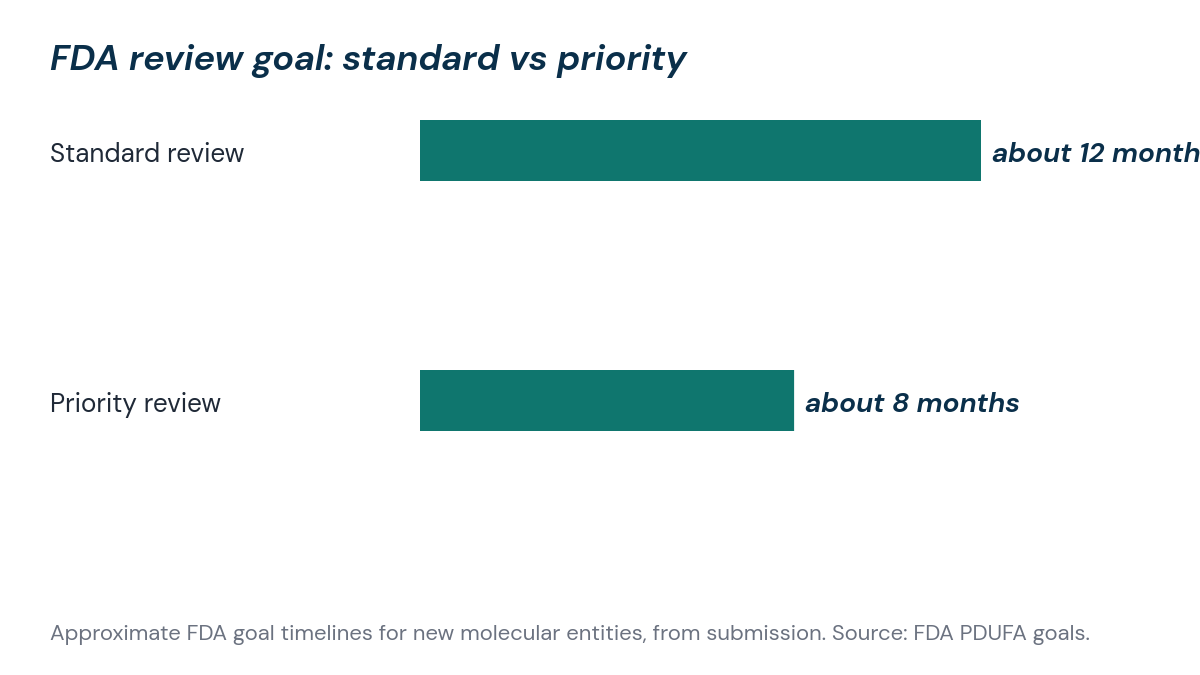
Two cautions apply. First, a shorter clock does not lower the evidence bar. Second, goal dates can move if the FDA asks for more information or extends the review. Priority Review improves the odds of a faster answer, not the odds of a yes.
What did the PROPEL 3 trial show?
The application rests on PROPEL 3, a Phase 3 placebo-controlled study in children with achondroplasia. The primary endpoint was annualized height velocity, which is simply how many centimetres a child grows in a year. The results below are as reported by the company; the full dataset and any peer-reviewed publication should be checked once available.
| Measure | Result reported by the company |
|---|---|
| Annualized height velocity (primary) | +2.10 cm per year versus placebo (p<0.0001) |
| Height Z-score | Improvement versus placebo (p<0.0001) |
| Body proportionality, ages 3 to 8 | Mean difference of −0.05 (p<0.05) |
| Arm span Z-score | +0.37 standard deviations (p<0.0001) |
| Safety | No discontinuations and no serious adverse events related to study drug |
One detail deserves honesty. Company materials also cite a least-squares mean difference of 1.74 cm per year alongside the 2.10 cm figure. The two numbers likely reflect different statistical presentations, but the summary we reviewed does not fully explain the gap, so we use the headline 2.10 cm figure as the company states it and flag the second number for readers who want to dig into the full analysis.
How does infigratinib work in achondroplasia?
Achondroplasia is caused by a change in the FGFR3 gene that makes the FGFR3 signal too active, which slows growth of the long bones (see the MedlinePlus overview). Infigratinib is a selective, oral small-molecule FGFR3 inhibitor. In plain terms, it is designed to turn down that overactive signal at its source so the growth plates can work more normally.
The company says roughly 55,000 people are affected in the US and EU, including up to about 10,000 children whose growth plates are still open, which is the group most likely to benefit from a growth-directed medicine.
Why would an oral option matter to families?
Treatment for a childhood condition is a long commitment. The targeted option currently on the market for achondroplasia is a daily injection, and any family that has managed daily injections knows the burden: scheduling, reluctance from young children and the sheer repetition over years. A medicine taken by mouth removes the needle from that routine. In our assessment, this convenience, if approval comes and the safety profile holds in broader use, could be as important to many families as the size of the growth effect itself.
That said, convenience is not proof of superiority. No head-to-head comparison has been reported, and we are not aware of any, so claims that one approach is better than another are premature.
What happens between now and February 2027?
- The FDA completes its review and may request additional data or hold an advisory discussion.
- Inspections of manufacturing and clinical sites may take place.
- Labelling, including age ranges and monitoring advice, is negotiated if the agency is leaning toward approval.
- The FDA acts on or before the 4 February 2027 goal date, or communicates a change.
Readers following rare-disease drug development may also want to see how other recent deals and trials are shaping the space, such as our coverage of the CSL and Alentis rare-disease partnership and the wider pharmaceutical news section.
Our assessment: what to watch
In our assessment, three things will decide how this story ends. The first is whether the FDA is comfortable with the long-term safety of blocking FGFR3 in growing children, since the trial reports only a limited period of exposure. The second is whether the growth gains translate into durable benefit, including body proportions and final adult height, which a one-year growth rate cannot show on its own. The third is access: pricing, reimbursement and the age range on the label will determine how many children actually receive the drug.
Frequently asked questions
Is infigratinib approved for achondroplasia?
No. As of 7 October 2026 it is an investigational medicine under FDA review. The decision goal date is 4 February 2027.
What is the PDUFA date for infigratinib?
The company states the PDUFA date as 4 February 2027, the date by which the FDA aims to complete its review of the application.
How is infigratinib taken?
It is an oral medicine, which is the central point of the development programme. Dosing details will be set by the label if the drug is approved.
How much did infigratinib increase growth in the trial?
The company reports a treatment difference of 2.10 cm per year in annualized height velocity versus placebo in PROPEL 3, with a statistically significant p-value below 0.0001.
Does a taller growth rate mean a taller adult?
Not automatically. Growth velocity is a strong early signal, but final adult height depends on how long the benefit continues. Long-term follow-up is needed to answer that.
Are there safety concerns?
The company reports no discontinuations and no serious adverse events related to the study drug. Those are sponsor-reported findings, and the FDA will conduct its own review.
How we reported this
This article draws on the company’s announcement of 6 October 2026 and on public medical and regulatory reference pages linked above. Trial results are company-reported and have not been independently verified by us. Statements marked as our assessment are opinion. Last updated 7 October 2026. This article is for general information and is not medical advice; speak to a qualified clinician about treatment decisions.