

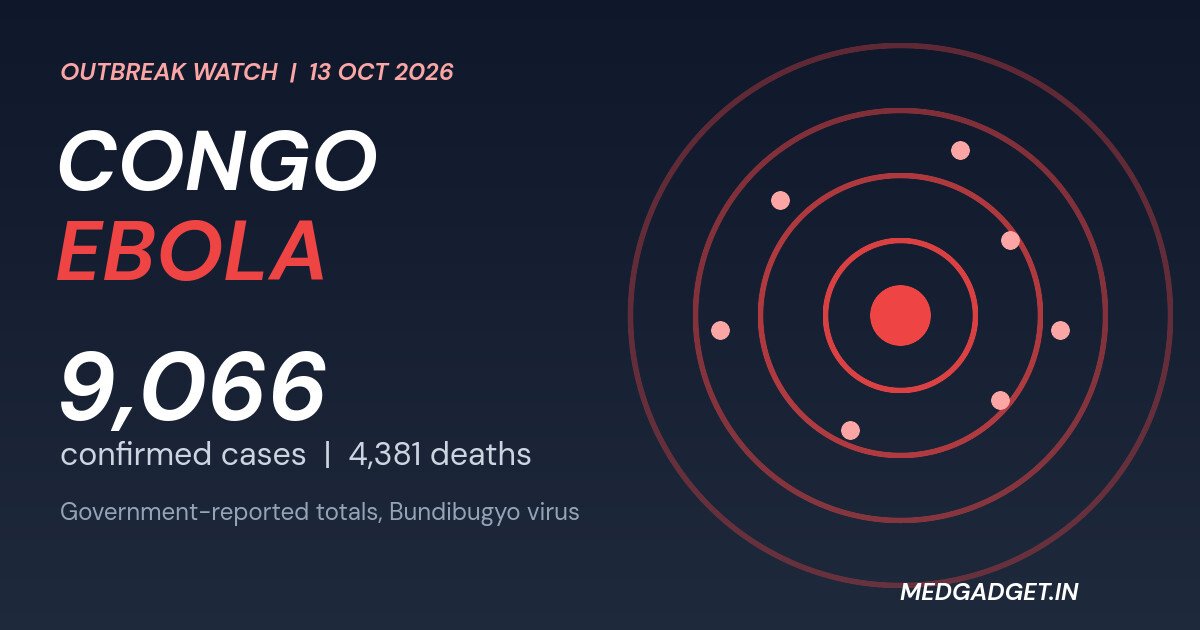
The Congo Ebola outbreak October 2026 has passed 9,000 confirmed cases. Figures reported by the Democratic Republic of the Congo’s government on 13 October put the total at 9,066 confirmed cases and 4,381 deaths in an outbreak of Bundibugyo virus that was declared in May 2026. These are national government totals. They have not been independently verified by the World Health Organization, whose latest published figures cover an earlier date and are lower.
Below we set the government numbers beside the latest data from WHO Disease Outbreak News, the European Centre for Disease Prevention and Control (ECDC) and the US Centers for Disease Control and Prevention, and explain what is confirmed, what is not, and why the totals keep moving.
Congo Ebola outbreak October 2026: key takeaways
- Government totals (13 October): 9,066 confirmed cases and 4,381 deaths.
- Latest WHO figures: 8,728 confirmed cases and 4,205 deaths as of 6 October, published on 8 October.
- Strain: Bundibugyo virus, for which there is no approved vaccine or specific treatment.
- Spread beyond Congo: Kenya confirmed one imported case, who died; Uganda reported 20 cases earlier in the year.
- WHO risk assessment (14 August): very high nationally, high regionally, low globally.
Congo Ebola outbreak October 2026: what the numbers show
WHO’s most recent outbreak notice, published on 8 October, reports 8,728 confirmed cases and 4,205 deaths in the DRC as of 6 October, a crude case fatality ratio of 48.2%, along with 2,269 recoveries. The notice does not report probable or suspected cases. The ECDC page, updated on 12 October with data up to 10 October, lists 8,978 confirmed cases, 4,336 deaths and 2,356 recoveries, with 945 people in isolation. It records 64 new cases and 21 deaths on 10 October alone.
The US CDC page, updated on 13 October with data to 10 October, adds the other countries: its combined total is 9,000 confirmed cases and 4,339 deaths, of which the DRC accounts for 8,978 and 4,336. The CDC notes that the DRC health ministry leaves probable and suspected cases out of its official counts, so the figures may change.
By our calculation, the government’s 4,381 deaths among 9,066 confirmed cases is a crude ratio of about 48.3%, very close to the 48.2% WHO reported for 6 October. Compared with WHO’s 6 October totals, the government figures are 338 cases and 176 deaths higher. That gap reflects a later cut-off date and a different reporting source rather than a confirmed discrepancy, but it is the reason this article does not describe the 9,066 and 4,381 figures as WHO-verified. A crude ratio of deaths to confirmed cases also includes people who are still ill, so it is not a final measure of how deadly the disease is.
Where the Congo Ebola outbreak October 2026 is spreading
WHO says confirmed cases have been recorded in 64 health zones across 7 of the DRC’s 26 provinces: Bas-Uélé, Haut-Uélé, Ituri, North Kivu, South Kivu, Sud-Ubangi and Tshopo. Ituri is by far the worst affected, with 6,480 confirmed cases and 2,989 deaths in WHO’s 6 October data, rising to 6,639 cases and 3,074 deaths in the ECDC’s figures to 10 October. North Kivu follows with 1,883 cases and 1,075 deaths. The newest affected zone is Alimbongo in North Kivu.
The trend is not falling. WHO reports about 487 new cases and 224 new deaths a week over its latest reporting weeks, up slightly from 475 and 222. Contact tracing is also behind plan: 80.4% of listed contacts (23,741 of 29,535) had been followed up as of 4 October, below WHO’s 85% target.
Cases outside Congo
- Kenya: the first laboratory-confirmed imported case was reported on 6 October. The patient, who had lived in the DRC, arrived in Nairobi on 3 October and died. As of 11 October the ECDC reported 108 of 122 listed contacts in quarantine without symptoms. See our earlier reports on the first Kenyan case and the follow-up testing in Kenya.
- Uganda: 20 cases were reported between May and June, and WHO declared that outbreak over on 25 August. Response measures, including contact tracing, restarted after the Kenyan case.
- Europe: medically evacuated patients have been treated in several European countries, and the ECDC rates the risk of importation to the EU and EEA as very low.
Why the Congo Ebola outbreak October 2026 is so hard to contain
Bundibugyo virus is one of three orthoebolaviruses known to cause large outbreaks. According to the WHO Ebola fact sheet, there is no approved vaccine or specific treatment for the disease it causes, although candidate products are in development. WHO held a vaccine prioritisation meeting on 31 July, and a clinical trial of treatments began enrolling patients on 2 July. That leaves control measures as the main tools: finding cases quickly, tracing contacts, isolating patients, infection control in health facilities and safe burials.
Ebola spreads through direct contact with the blood or body fluids of a sick or dead person, or with contaminated objects. WHO says people cannot transmit the virus before they have symptoms, and the incubation period is 2 to 21 days. Health workers are often infected when infection control slips, and burial ceremonies involving direct contact with the body can also spread the virus. Those routes explain why contact follow-up and community engagement matter as much as laboratory capacity.
For another current example of an outbreak under WHO monitoring, see our report on the Yemen cholera surge, and for the situation earlier in the response read our report on the UN warning that the response will take months. You can also browse more healthcare services news.
Risks and caveats for the Congo Ebola outbreak October 2026
- Reporting gaps: official counts cover confirmed cases only, so the true number of infections may be higher.
- Different dates: WHO, ECDC, CDC and the government publish figures with different cut-off dates, so totals should not be compared without checking the date.
- Unverified totals: the 9,066 and 4,381 figures are government-reported and have not been independently confirmed by WHO.
- Travel advice differs: WHO advises against travel or trade restrictions based on current information, while the US restricts entry for people who were in the DRC in the previous 21 days and lists Ituri and North Kivu at its highest travel-notice level.
- Risk can change: WHO’s risk assessment is dated 14 August, and a separate rapid assessment for Kenya is still in progress.
In our assessment, crossing 9,000 is a symbolic threshold rather than a turning point. The more telling numbers are the roughly 480 new cases a week that WHO is still recording and a contact follow-up rate that remains below target. Until those improve, the outbreak is likely to keep growing in the provinces already affected, and further cross-border cases remain possible.
What to watch next in the Congo Ebola outbreak October 2026
- The next WHO outbreak notice and whether the weekly case count moves above or below about 487.
- Whether contact follow-up reaches WHO’s 85% target.
- New health zones or provinces reporting confirmed cases.
- Kenya’s contact-tracing results: by our calculation, the 21-day monitoring window for contacts exposed around the patient’s death on 5 October would end in the last week of October.
- Results or enrolment news from the treatment trial and any vaccine candidates.
Frequently asked questions
How big is the Congo Ebola outbreak October 2026?
The government reported 9,066 confirmed cases and 4,381 deaths on 13 October. WHO’s latest published figures are 8,728 confirmed cases and 4,205 deaths as of 6 October.
What is Bundibugyo virus?
It is one of the viruses that cause Ebola disease. WHO describes it as one of three orthoebolaviruses known to cause large outbreaks, and there is no approved vaccine or specific treatment for the disease it causes.
Is the Congo Ebola outbreak October 2026 a risk to travellers?
WHO’s assessment of 14 August rated the global risk as low and the risk to countries bordering the DRC as high. The ECDC rates the risk of importation to the EU and EEA as very low. Travellers should follow their own country’s current advice.
Which countries have reported cases in the Congo Ebola outbreak October 2026?
The DRC has almost all of them. Uganda reported 20 cases earlier in 2026, and Kenya confirmed one imported case on 6 October. Some patients have also been medically evacuated to Europe.
How does Ebola spread?
Through direct contact with the blood or body fluids of a sick or dead person, or with contaminated objects. People cannot spread the virus before they have symptoms.
How we reported this: we compared the figures reported by the Congolese government on 13 October with the latest published WHO, ECDC and CDC updates and the WHO fact sheet. Figures labelled as ours are our own calculations. The 9,066 and 4,381 totals have not been independently verified by WHO. Last updated: 14 October 2026. This article is news reporting and not medical advice.
[…] evidence from ECDC that the illness itself has become worse. For other public health coverage, see Congo Ebola Outbreak October 2026: Alarming Rise Past 9,000 and our healthcare services section. ECDC publishes a weekly West Nile virus report updated during […]
[…] measures to track are new provinces, contact follow-up and cases among health workers. See also Congo Ebola Outbreak October 2026: Alarming Rise Past 9,000 and Kenya Ebola Outbreak October 2026: 0 New Cases in 293 Tests. More in our healthcare services […]